I slept very well again and woke up relaxed, enjoying a coffee in bed and eating some pastry I had bought the night before. I love when I can ease into the day.
However, I had planned a train trip for this day, so it didn’t make sense to linger too much. At some point, I got ready and set off.
The simplest and most direct route to the station was via the pedestrian bridge over the Limmat River in Zurich and since it had snowed the previous day, the views were very beautiful.
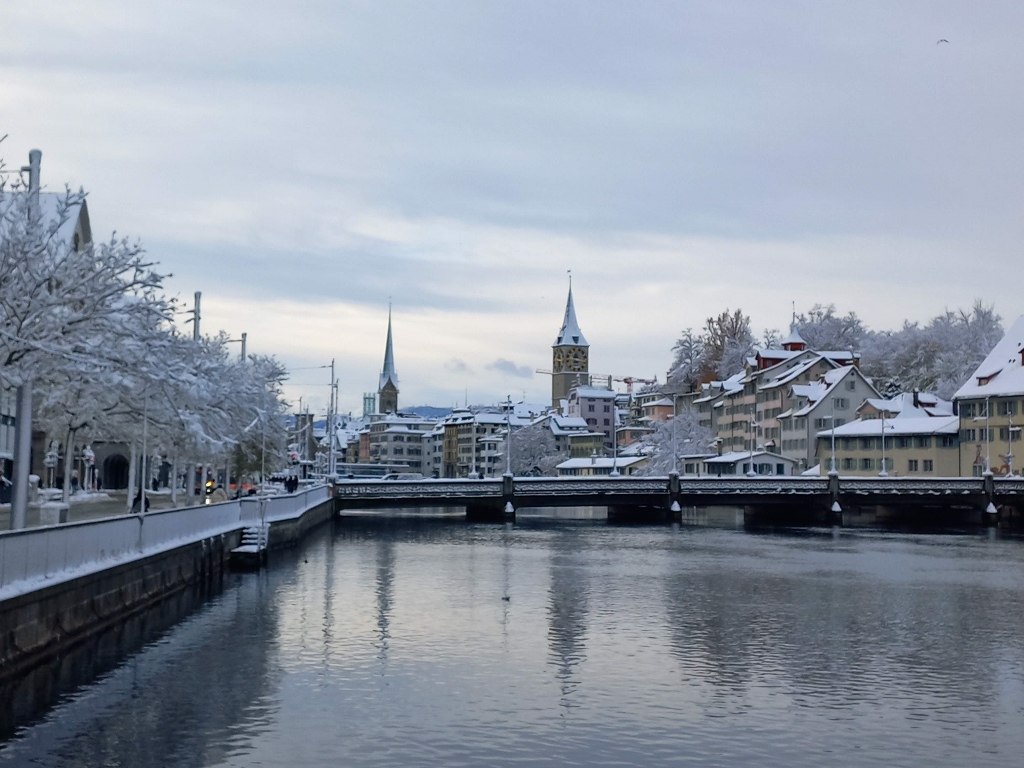 Zurich
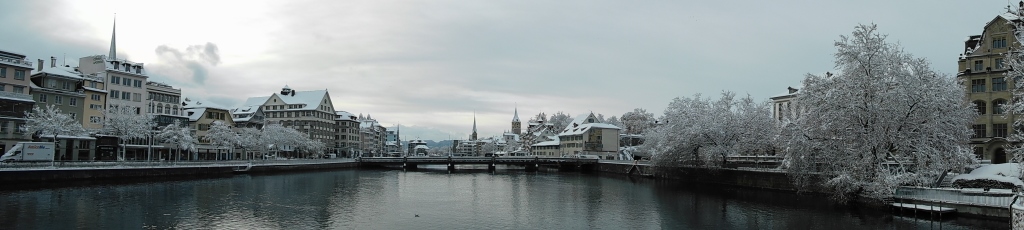 Zurich
When I arrived at the train station and bought my ticket, I was a bit surprised because most of the trains were delayed. This was surely due to the snow that had fallen heavily the day and night before, but on the other hand, the delays were only between 3 and 13 minutes. So, it was negligible. In my country, such trains would be considered "on time like Swiss watches." It’s well-known that the Swiss are punctual and that makes sense since they are also famous for their watchmaking industry. I’m not sure which influenced which – people influenced the watches or vice versa – but the fact remains that Swiss watches are among the most famous, respected and reliable in the world.
Moreover, my trip today took me first to the town of Schaffhausen, where one of the most famous watchmaking companies is located.
However, every time I came across the name of the town Schaffhausen while planning this trip, I would chuckle to myself because it inevitably reminded me of one of my favourite comedy films, which I’ve already mentioned in my travel stories (see: https://www.svudapodji.com/en/french-riviera-4/). In that film, there is a character called "Dr. Emil Schaffhausen". I’m sure the filmmakers turned everything upside down and had a lot of fun coming up with character names and place names.
In real life, Schaffhausen is quite a serious place. Not only are very good watches made here, but it is also an old town located on the northern bank of the Rhine, full of beautiful buildings. It is also the capital of the canton of the same name, which is the northernmost canton in Switzerland.
But the main reason to visit this place is related to the Rhine River, which flows through the modern city and a few kilometres further creates exceptionally beautiful waterfalls. It is the existence of these waterfalls that has been significant for the development of the city. Since it was impossible for vessels to safely pass the waterfalls, it was necessary to interrupt travel and transport at one point and continue them a few kilometres further. This also created the need for a human settlement.
Although there is the option to take a local train from Zurich directly to Neuhausen am Rheinfall, which is where the waterfalls are officially located (and it’s considered a neighbouring settlement to the larger Schaffhausen), I decided to go directly to the larger city, take a little walk there first and then head to the waterfalls by local train.
Along the way, I marvelled at the snow-covered landscapes. Although the train passed through relatively flat terrain rather than the high mountains Switzerland is known for, it didn't diminish the impression in the slightest.
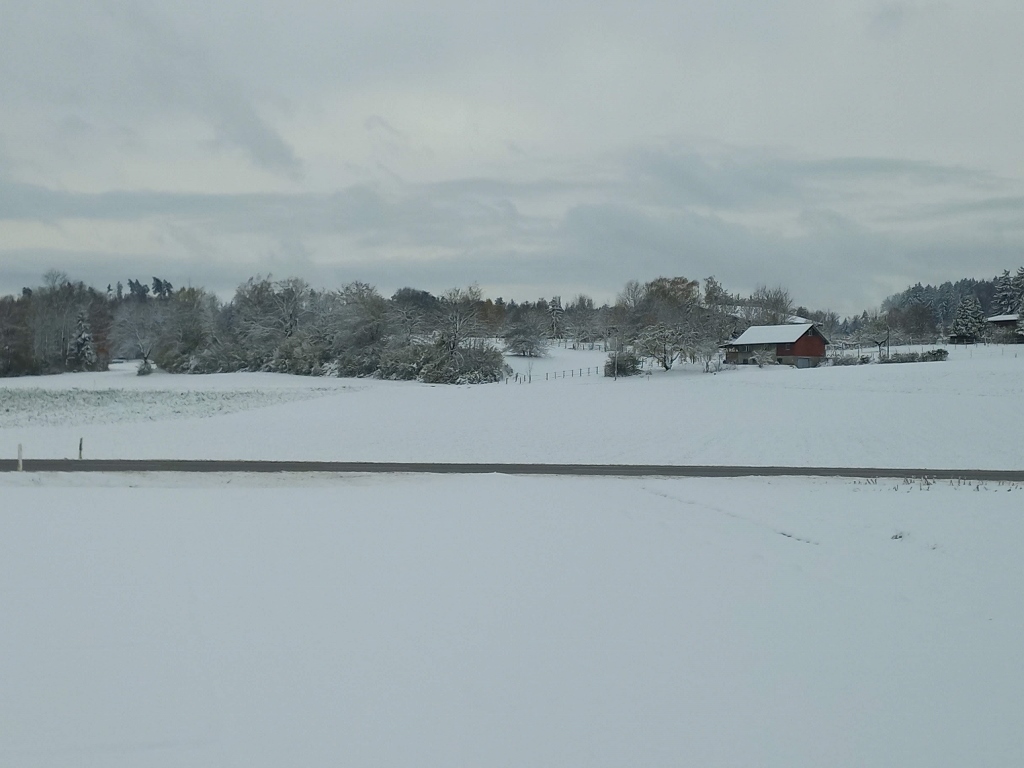 Switzerland in winter
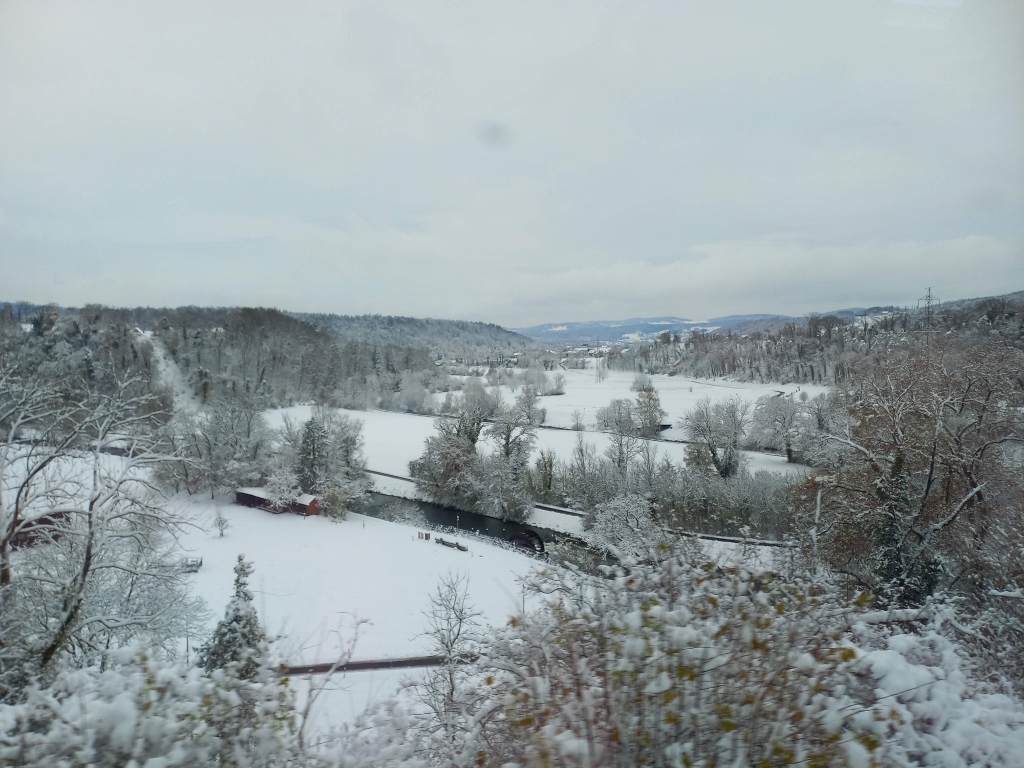 Switzerland in winter
Also, there is a map below showing the places I visited during my stay in Switzerland in late November 2024.
Near Schaffhausen, the railway crosses high over the Rhine, but when the train gets closer to Neuhausen, it’s better to sit on the right-hand side of the carriage, as you get an absolutely stunning view of the waterfalls I have mentioned. I’ll say a little more about the waterfalls later on.
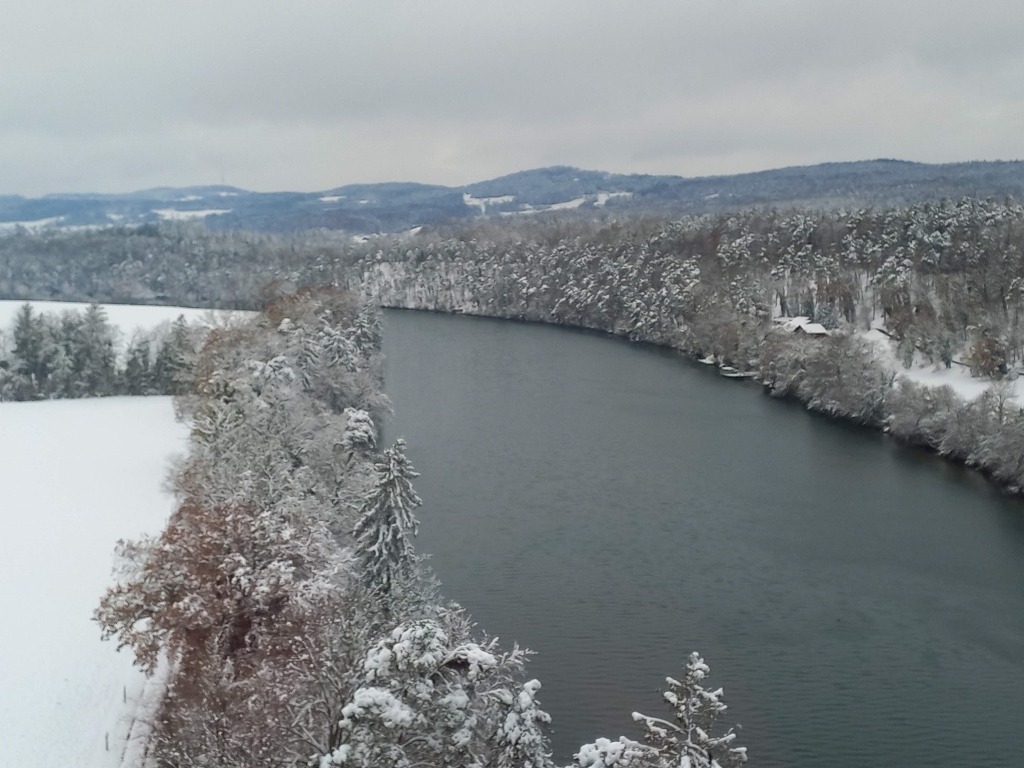 Rhine in its calm section
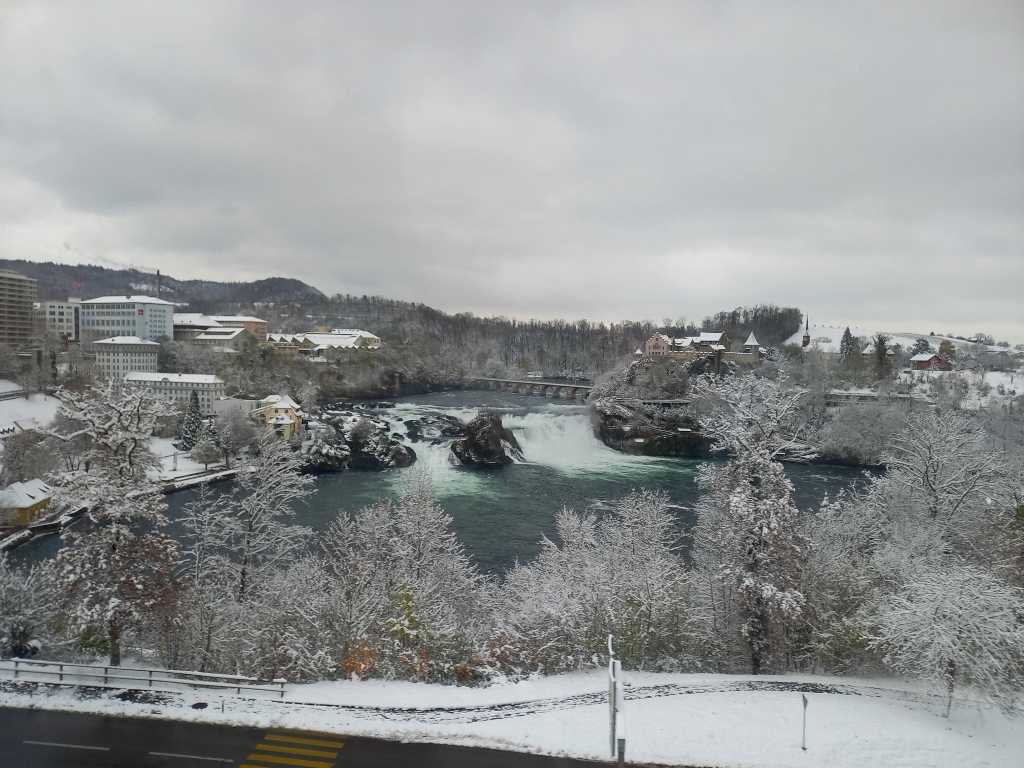 The Rhine Falls
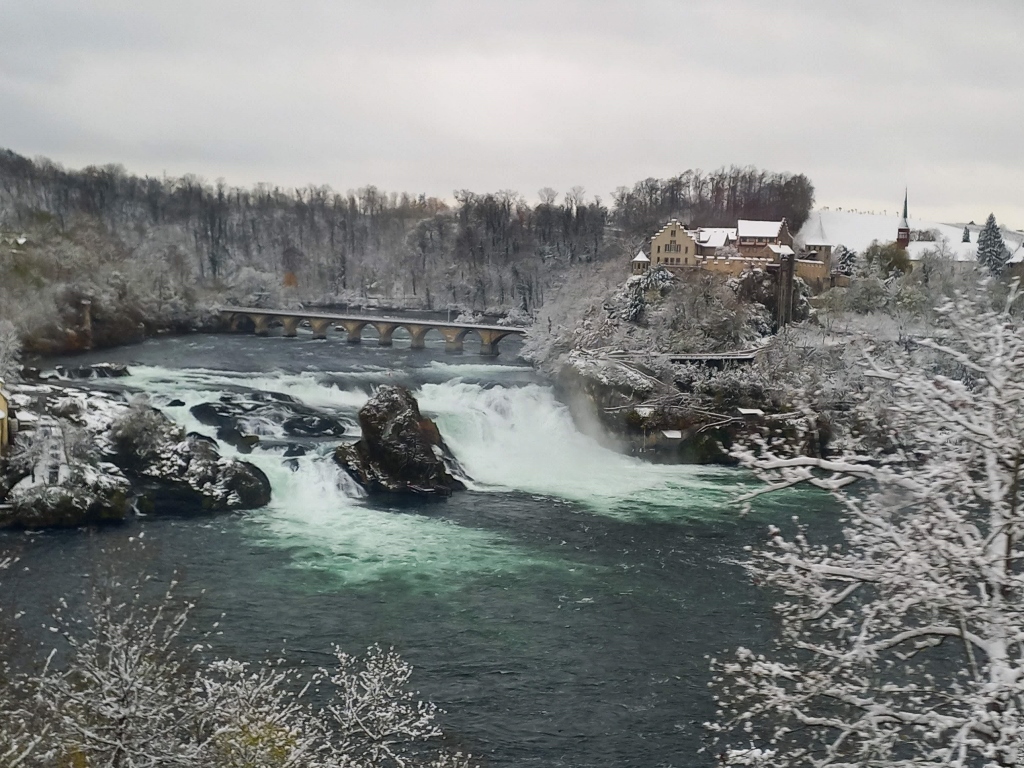 The Rhine Falls
Upon arriving in Schaffhausen, I first gathered some fresh information about the train schedule at the station and then I set off for a walk. The main streets are very close to the station.
Right from the start, I came across buildings with beautifully painted facades, where oriel windows stood out.
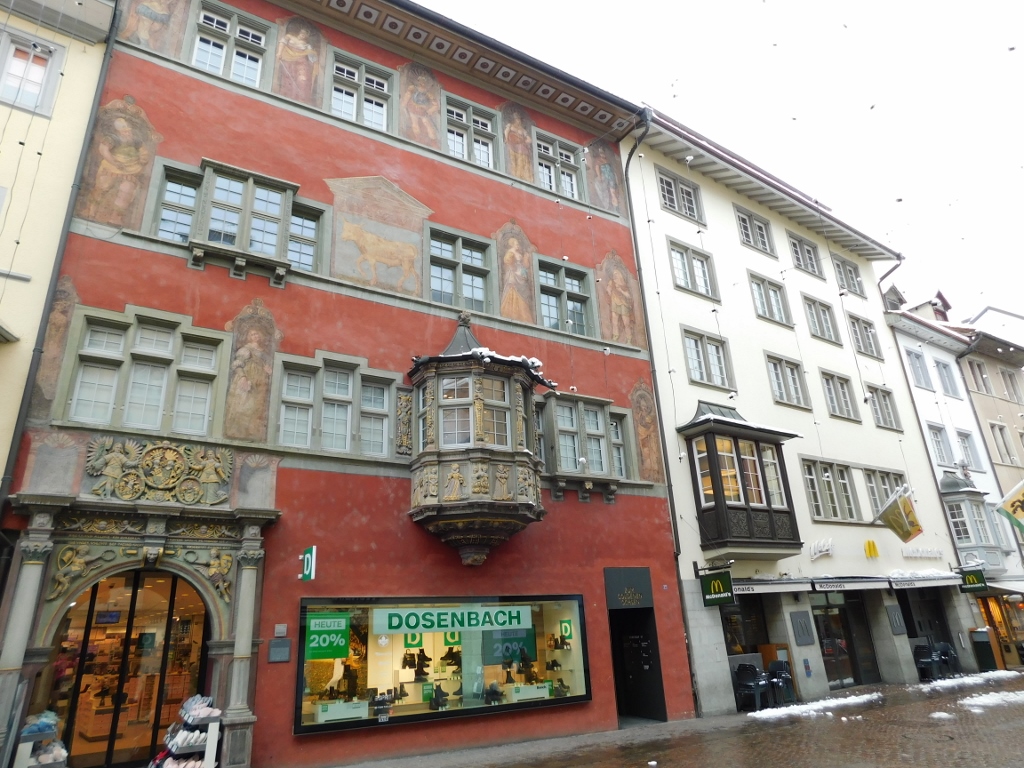 Schaffhausen, a detail
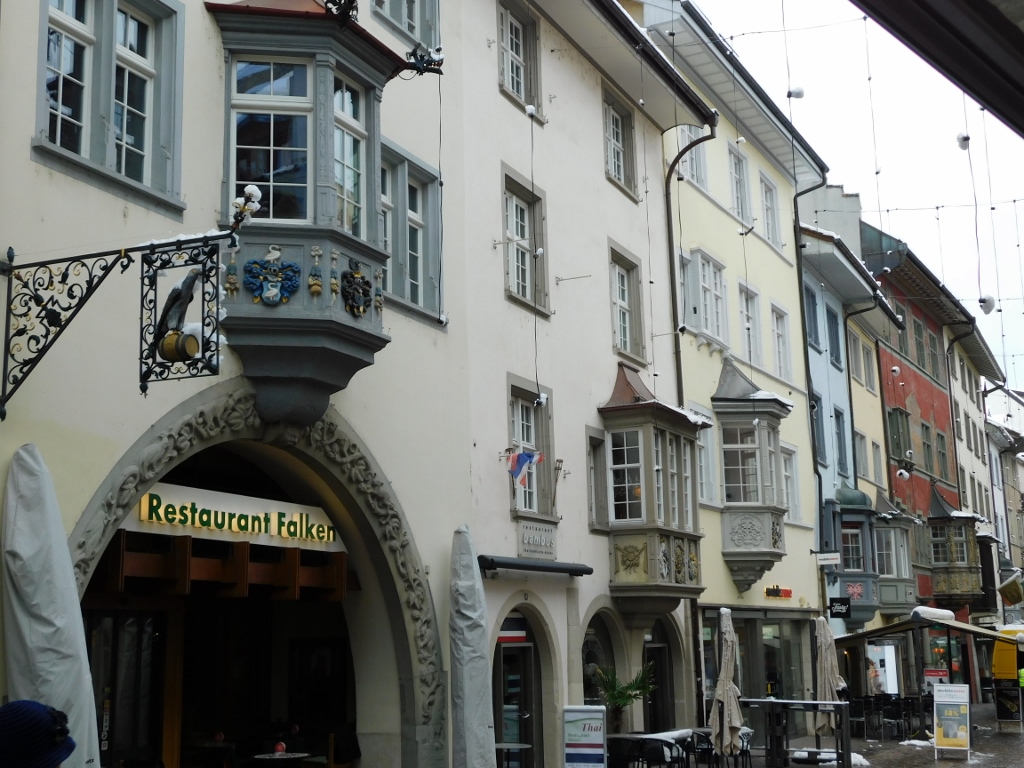 Schaffhausen, a detail
A little further on, I also saw the Schwabentor tower, but aside from taking a photo of it, I didn’t go toward it. Instead, I headed in the opposite direction toward the city centre.
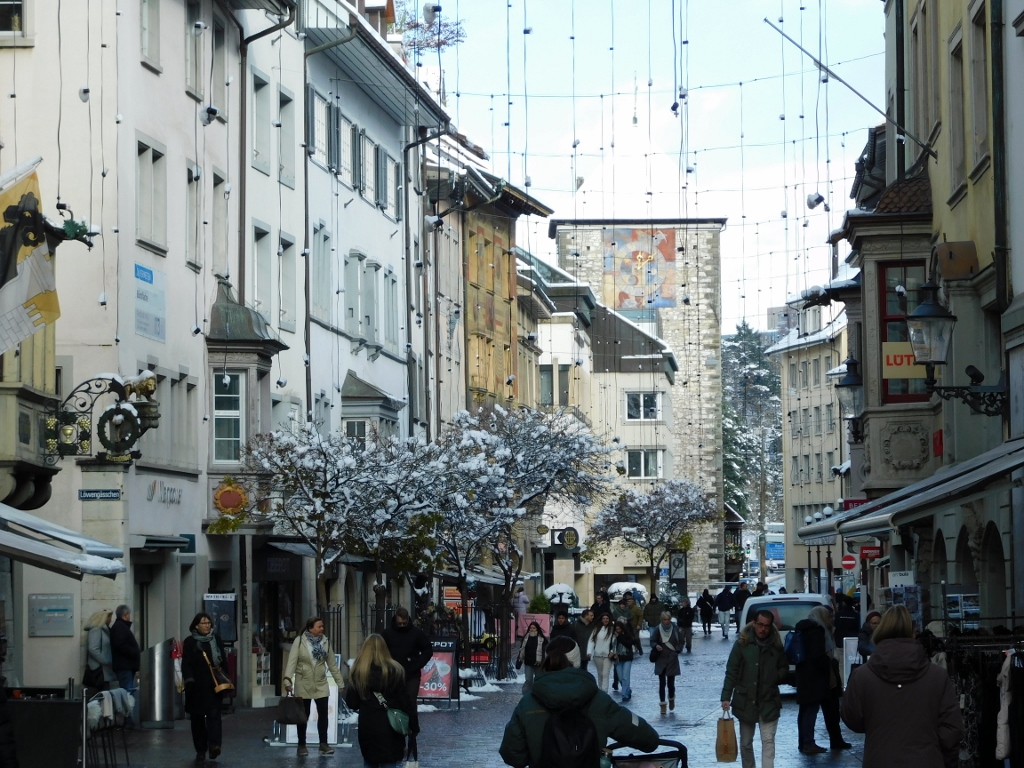 Schaffhausen, a detail
There, I first came to the long, roughly rectangular Fronwagplatz square, which has two fountains. It seemed that neither the snow nor the cold bothered the water or the flowers at all.
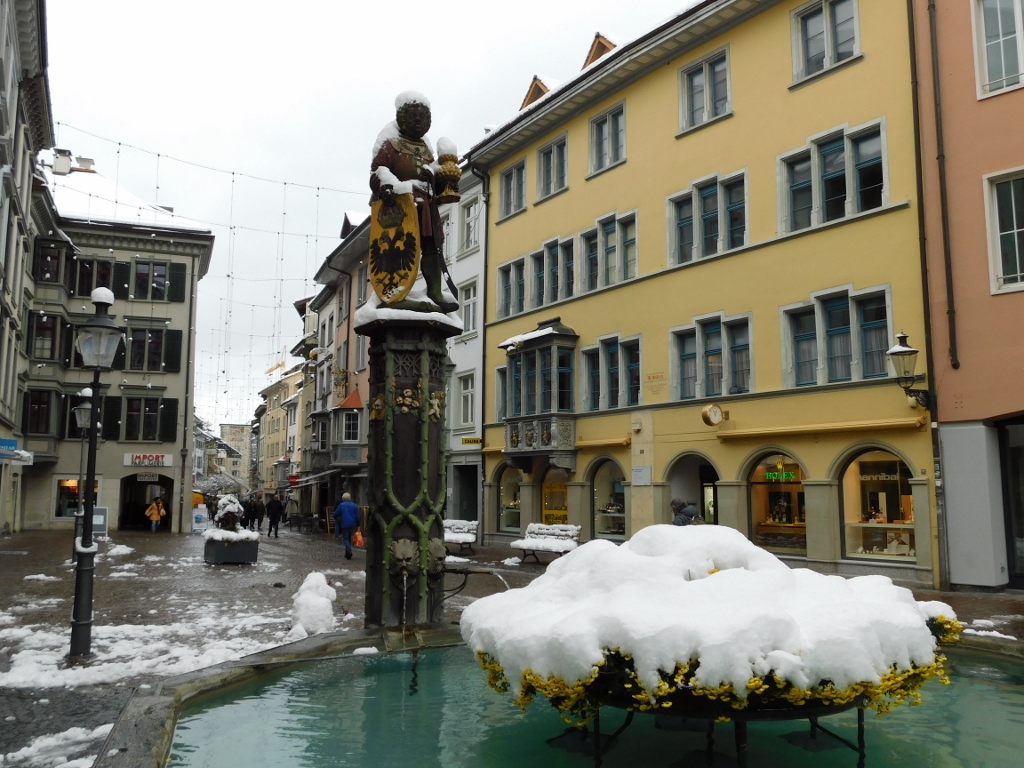 Schaffhausen, a detail
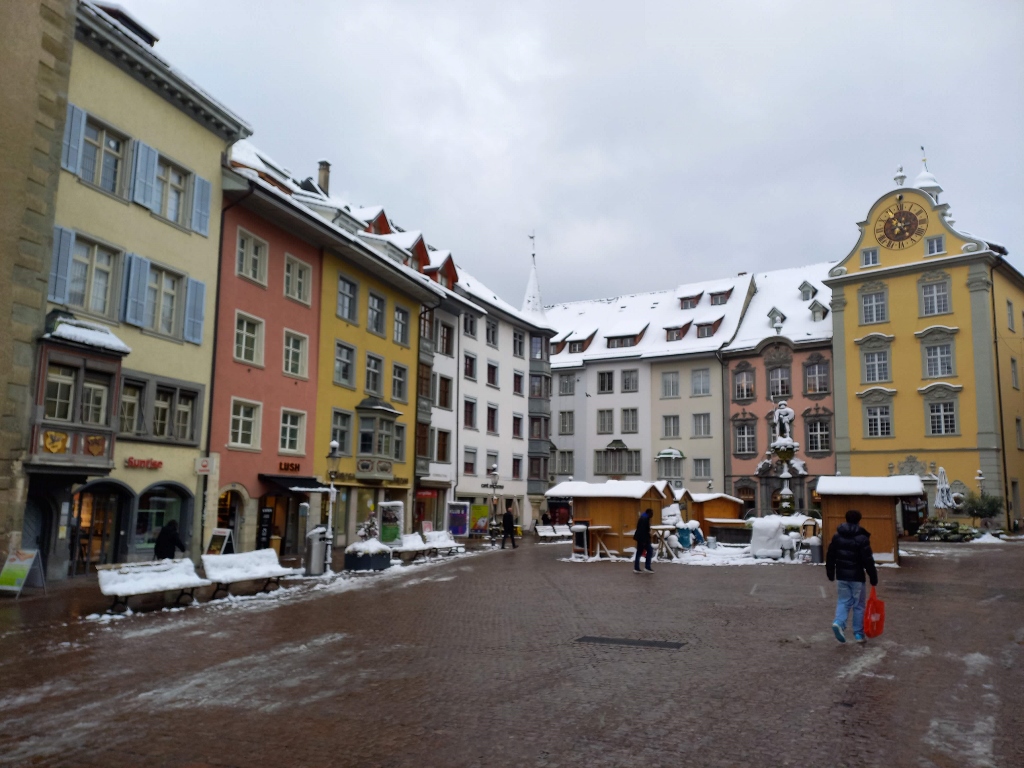 Fronwagplatz square
From here, I took one of the main streets heading east, Vodergasse, which is beautiful on its own, but it also features the particularly impressive "Knight’s House" or Haus zum Ritter.
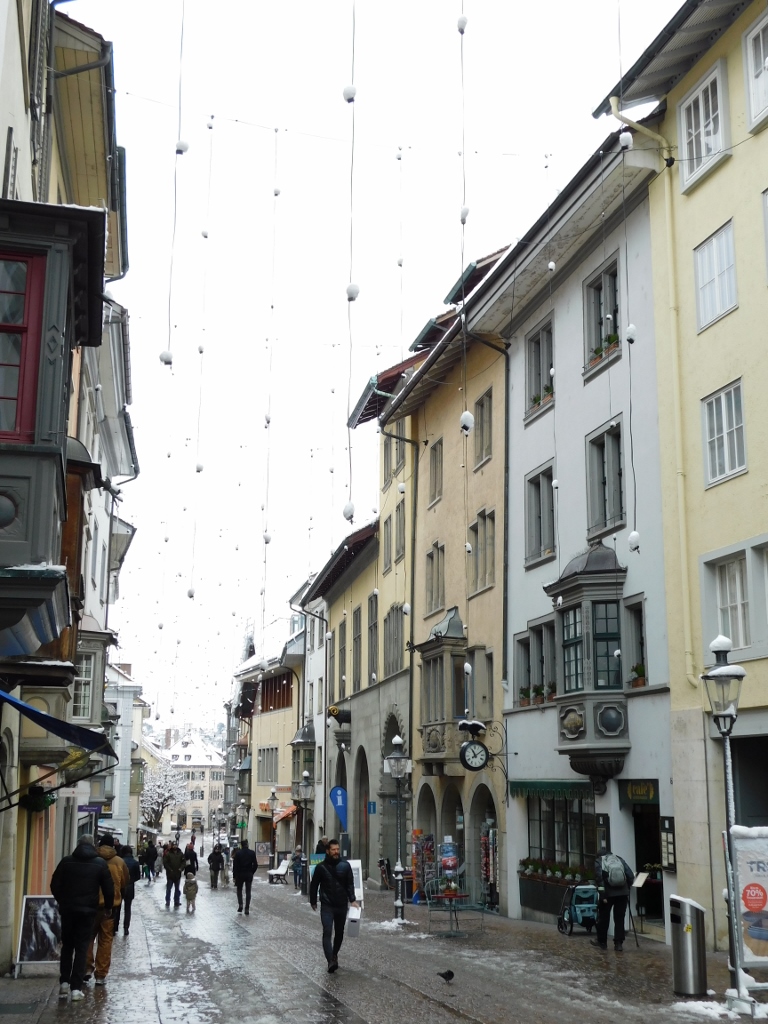 Schaffhausen, a detail
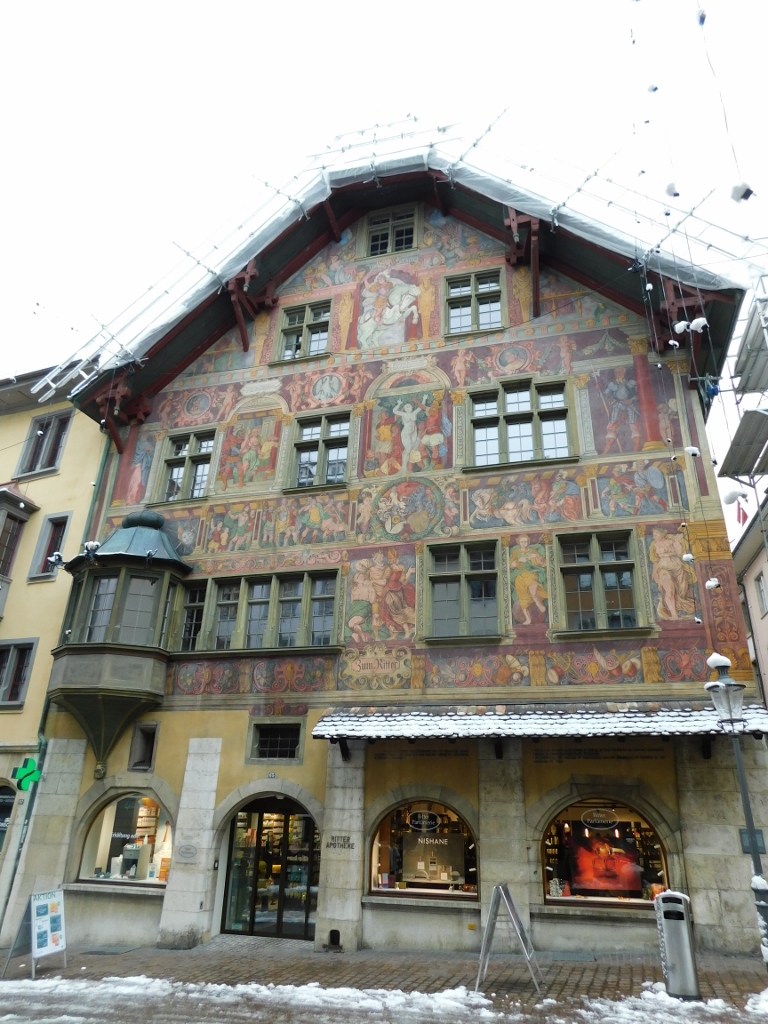 Knight’s House
At the time of my visit, the building had some scaffolding on its side, but the façade for which it is famous was still clearly visible. The original paintings on its façade are now housed in a museum, while the ones you see today were painted in 1943.
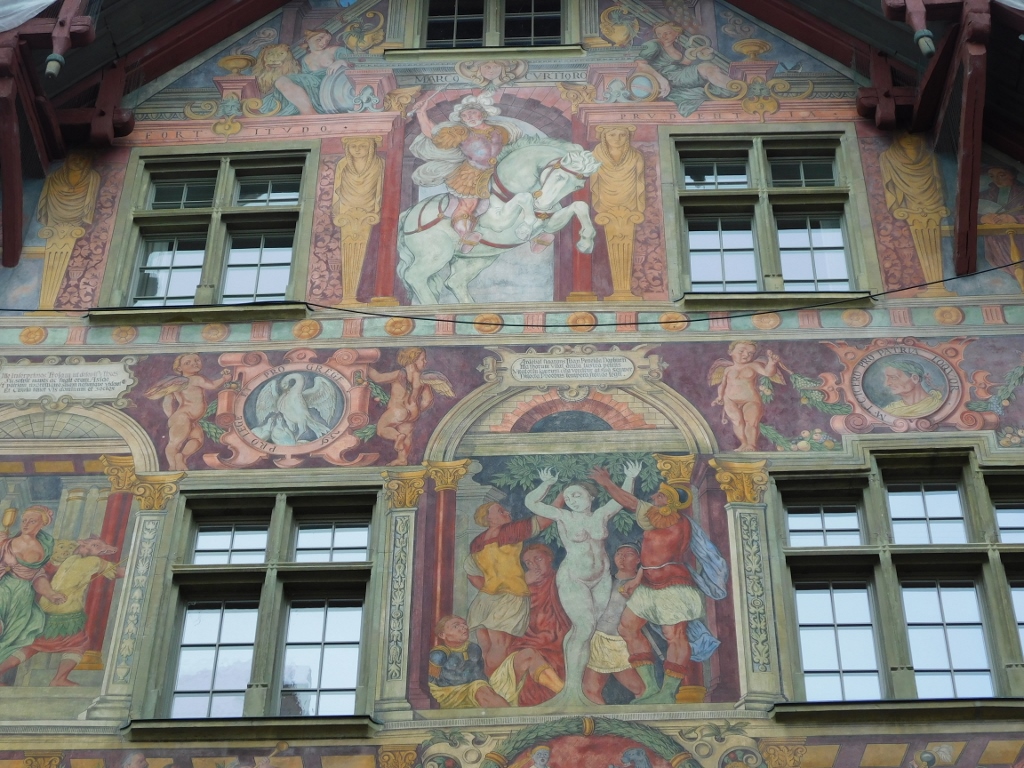 Knight’s House, a detail
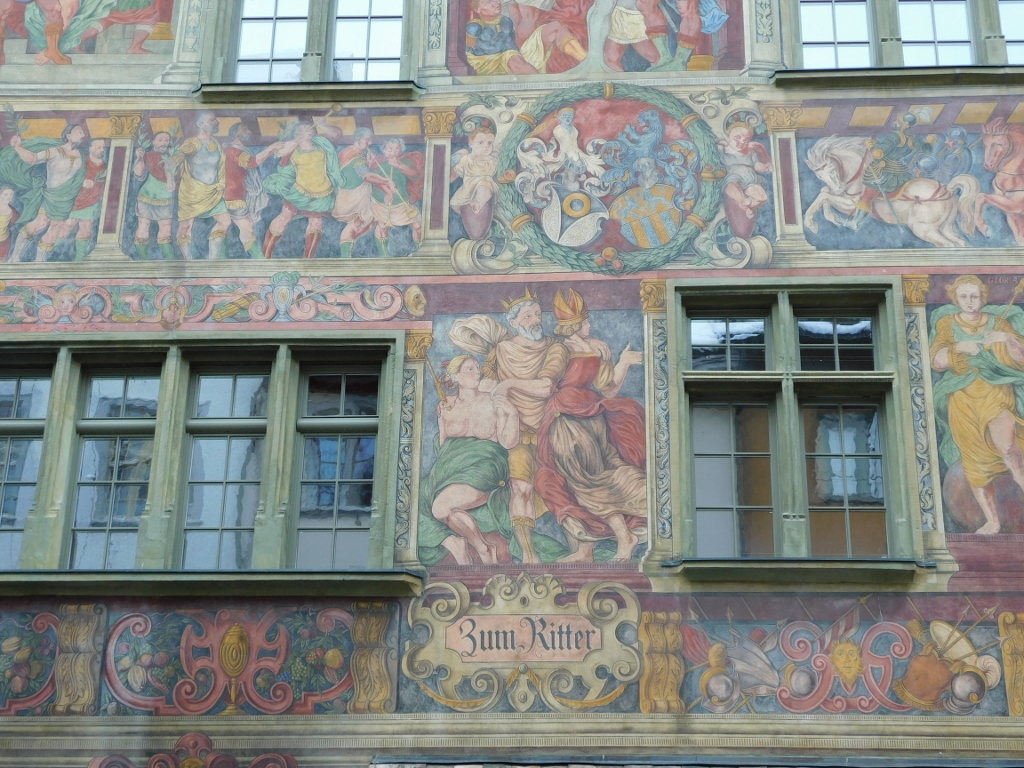 Knight’s House, a detail
However, the other houses on this street are also quite lovely and at the end, you come across a small square with a fountain once again.
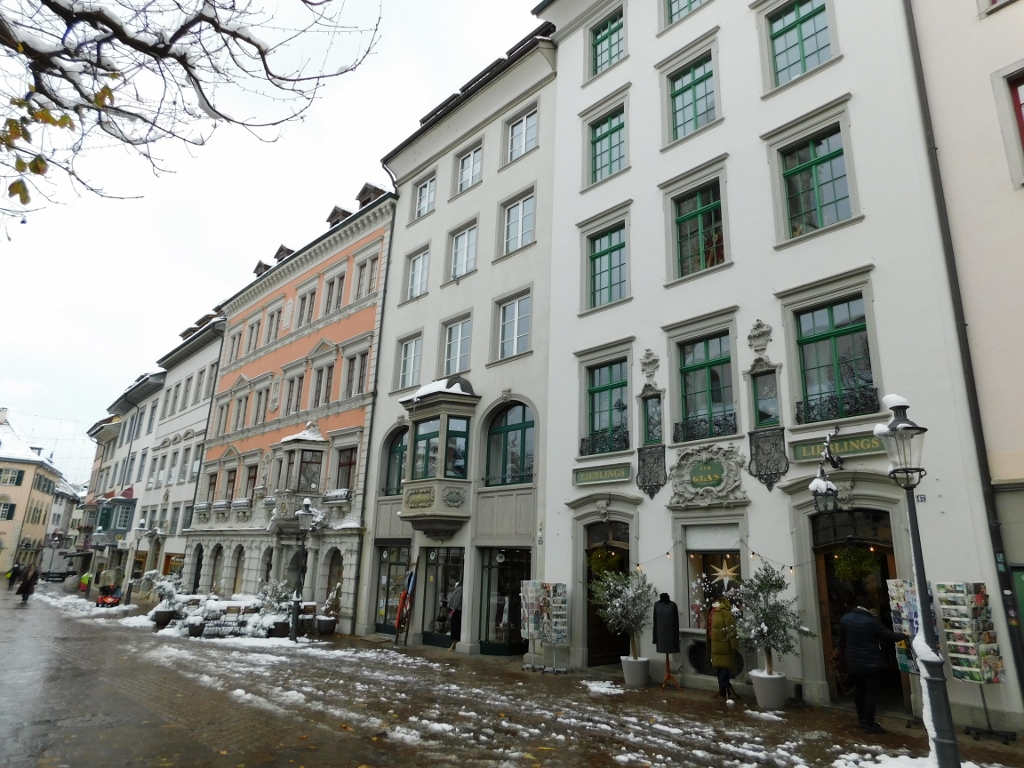 Schaffhausen, a detail
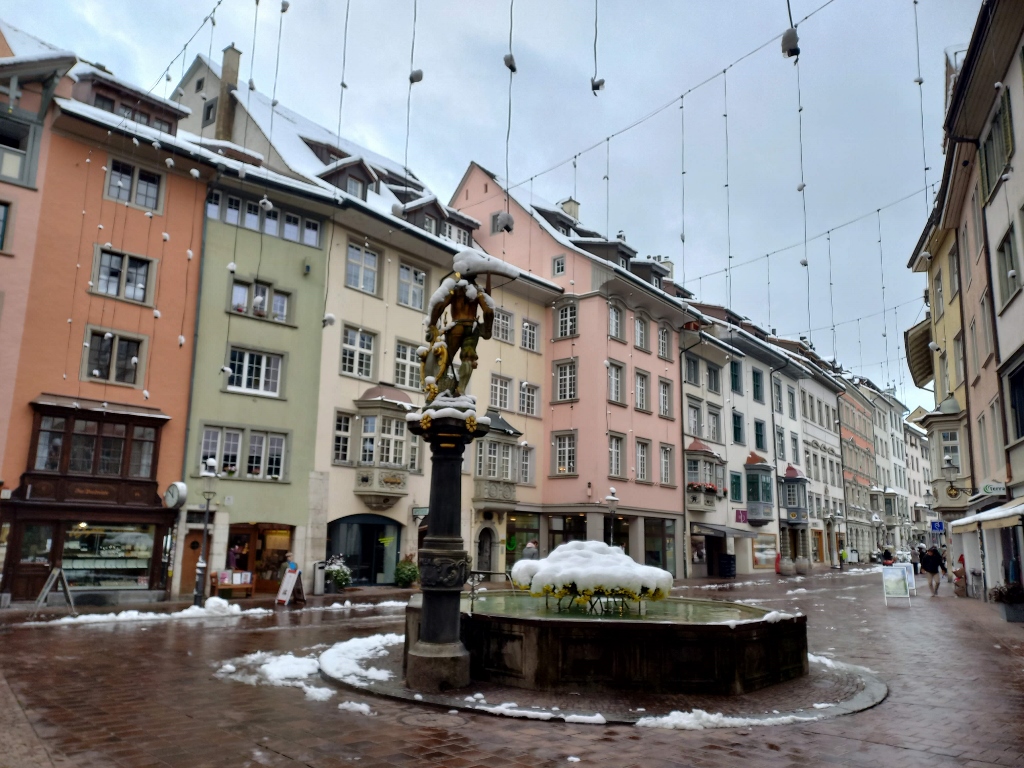 Schaffhausen, a detail
I then wandered a bit into some side streets, but I didn’t have much to walk. The centre of Schaffhausen is a small area, so it’s easy to see some of the most interesting buildings. One of them is the All Saints’ Church, but I approached it from the side of the City Library.
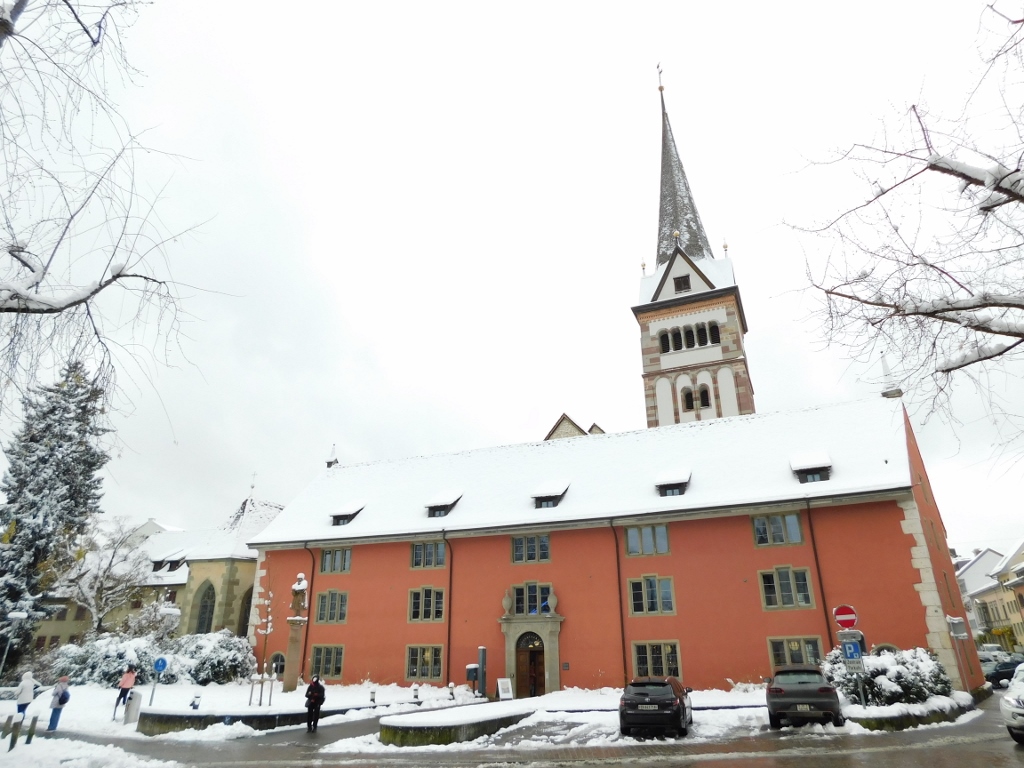 Schaffhausen, a detail
The church was built in the 11th century as a basilica in the Romanesque style for the needs of the then Benedictine monastery. In the 16th century, during the Reformation, the monastery was dissolved, while the church became the second important church in the city of Schaffhausen.
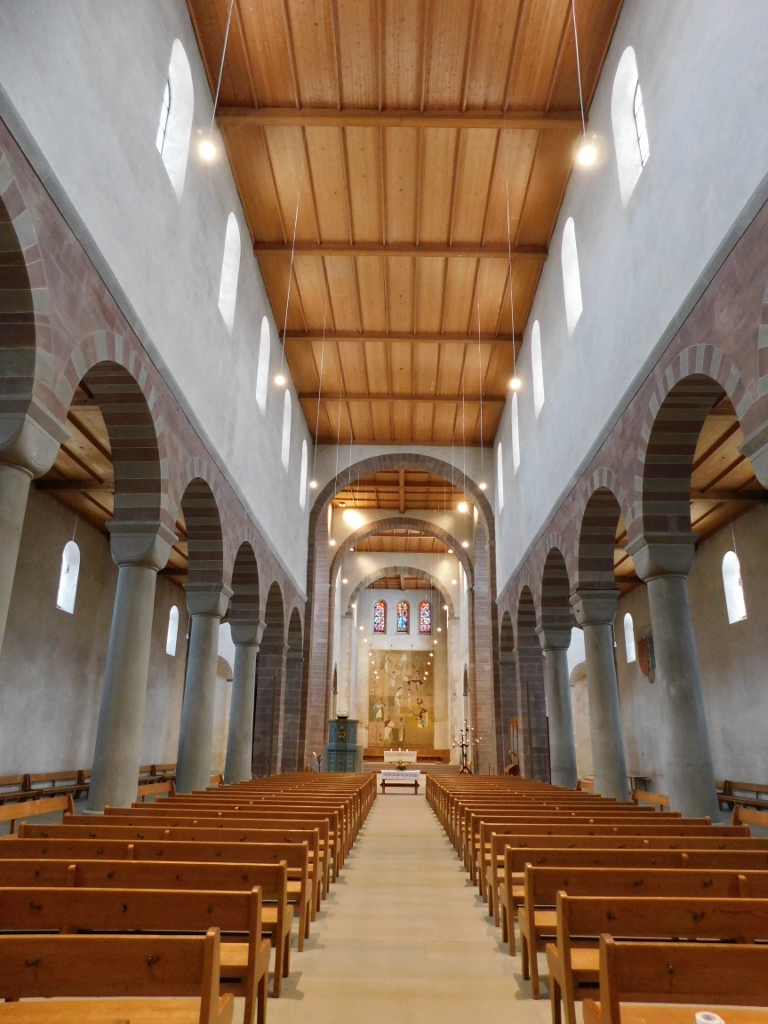 All Saints’ Church
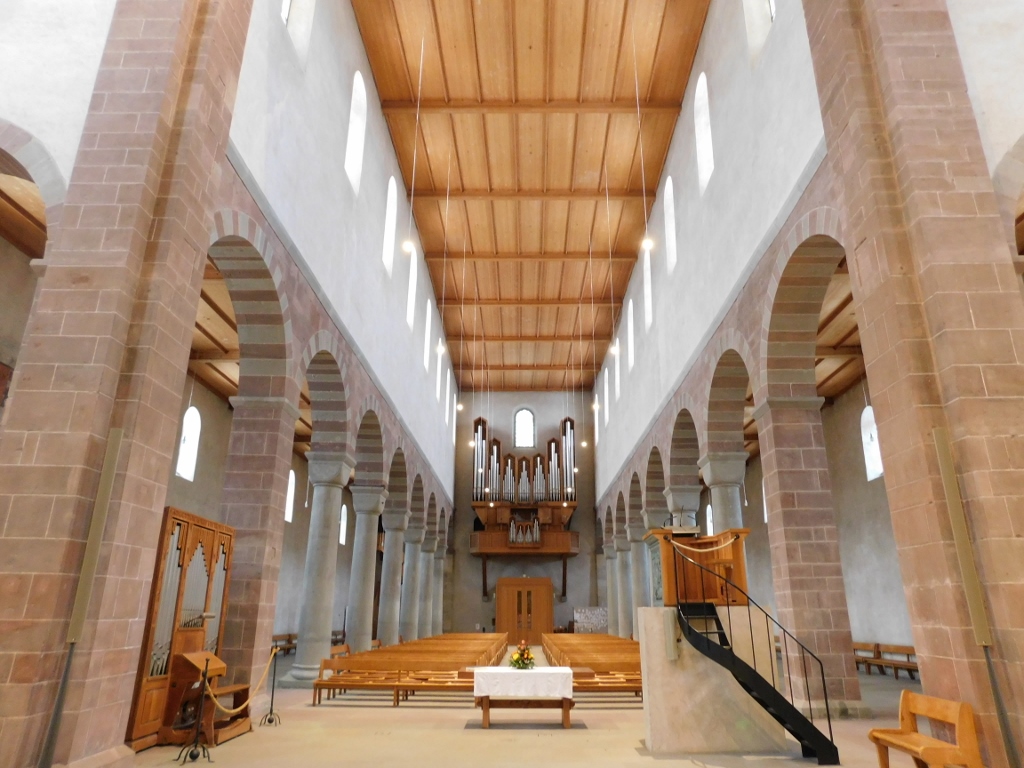 All Saints’ Church
The interior of the church is very beautiful, simple, yet elegant, and in a few places, you can spot interesting details, such as a wall painting near the chancel.
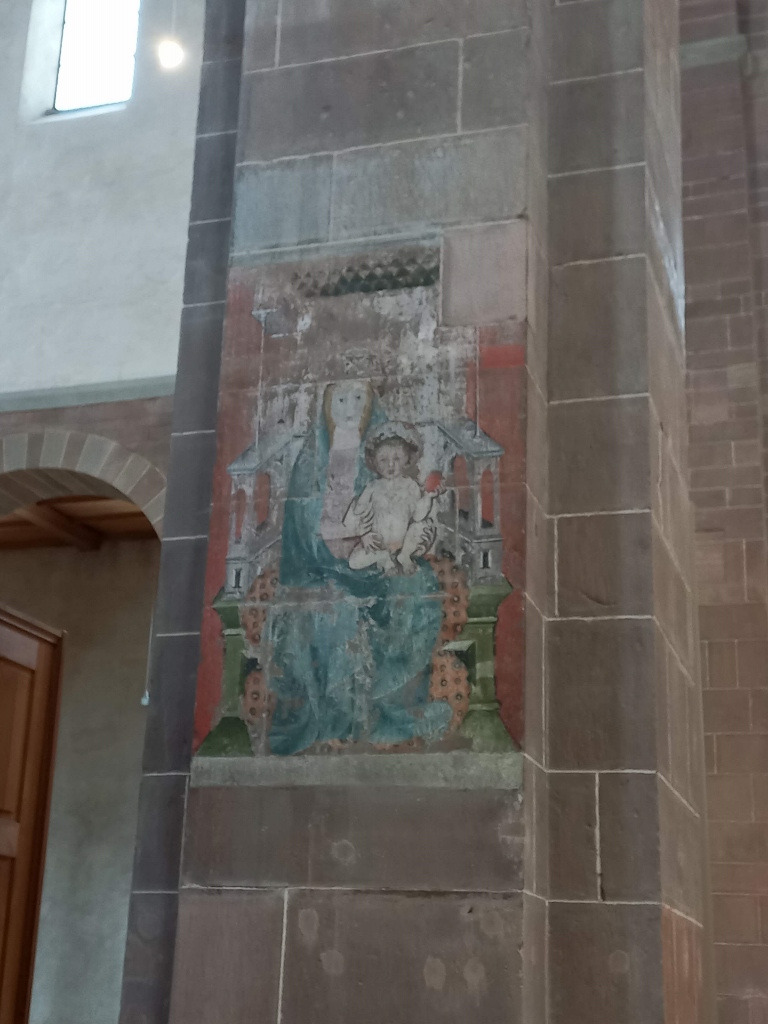 All Saints’ Church, a detail
Within the complex to which the church belongs, there is also a very beautiful cloister, as well as a museum. I visited the cloister, but not the museum.
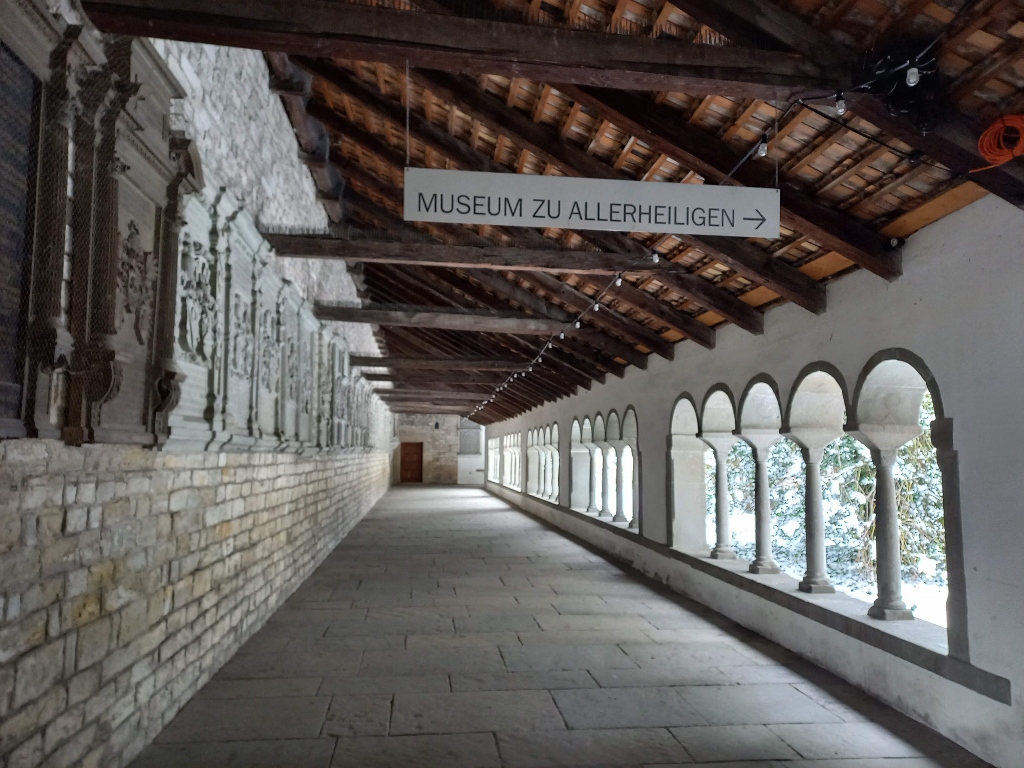 All Saints’ cloister, a detail
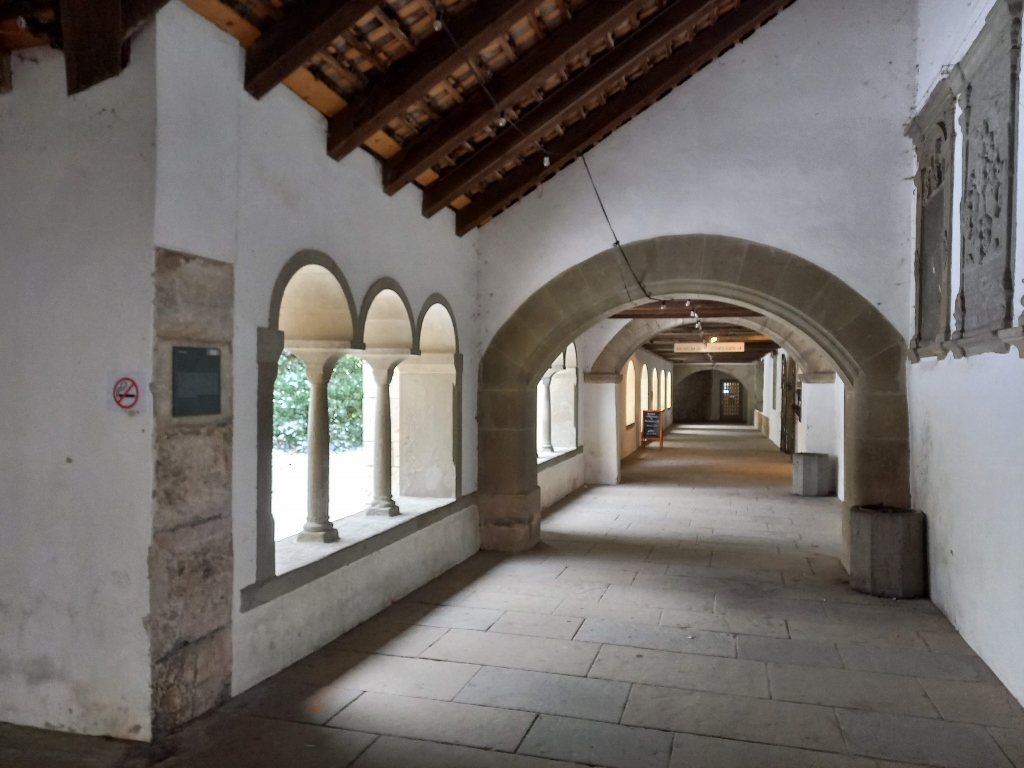 All Saints’ cloister, a detail
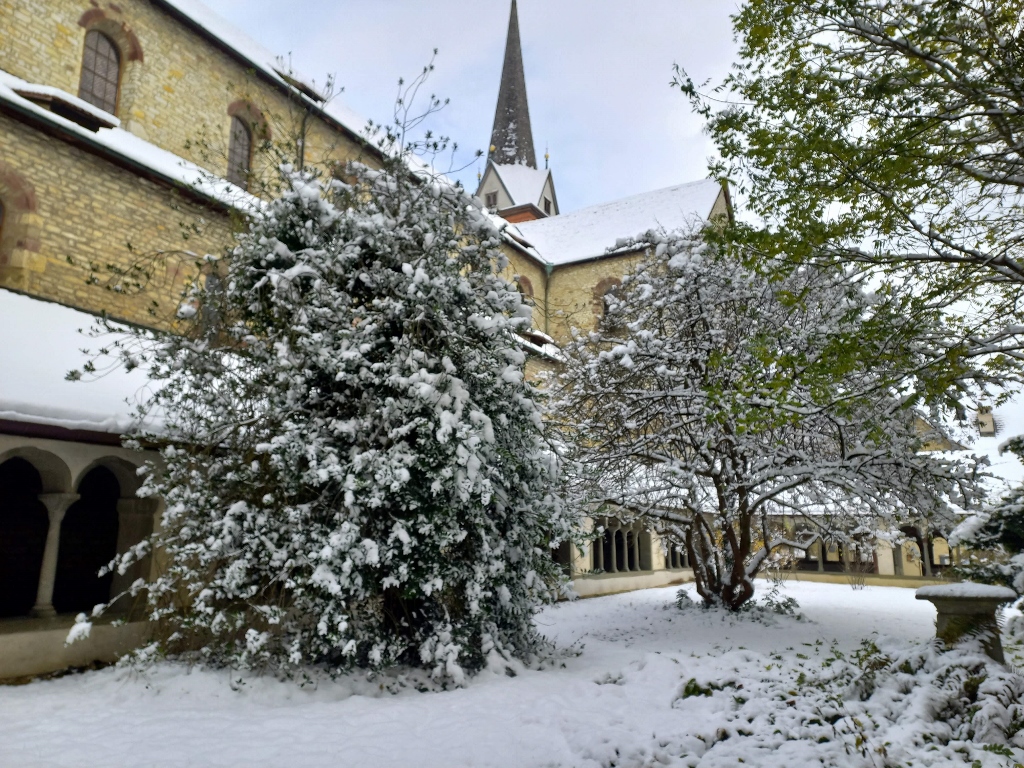 All Saints’ cloister, a detail
On this trip, I was more interested in walking around and observing the streets, landscapes and buildings from the outside, and only occasionally would I enter a church. I completely skipped museums. I need to be particularly inspired to visit them.
As for the buildings I observed from the outside, when I moved a bit further, walking up a street that gently ascends, I had a much better view, if not of the entire church, at least of its tower. (By the way, the white building visible on the right has nothing to do with the church.)
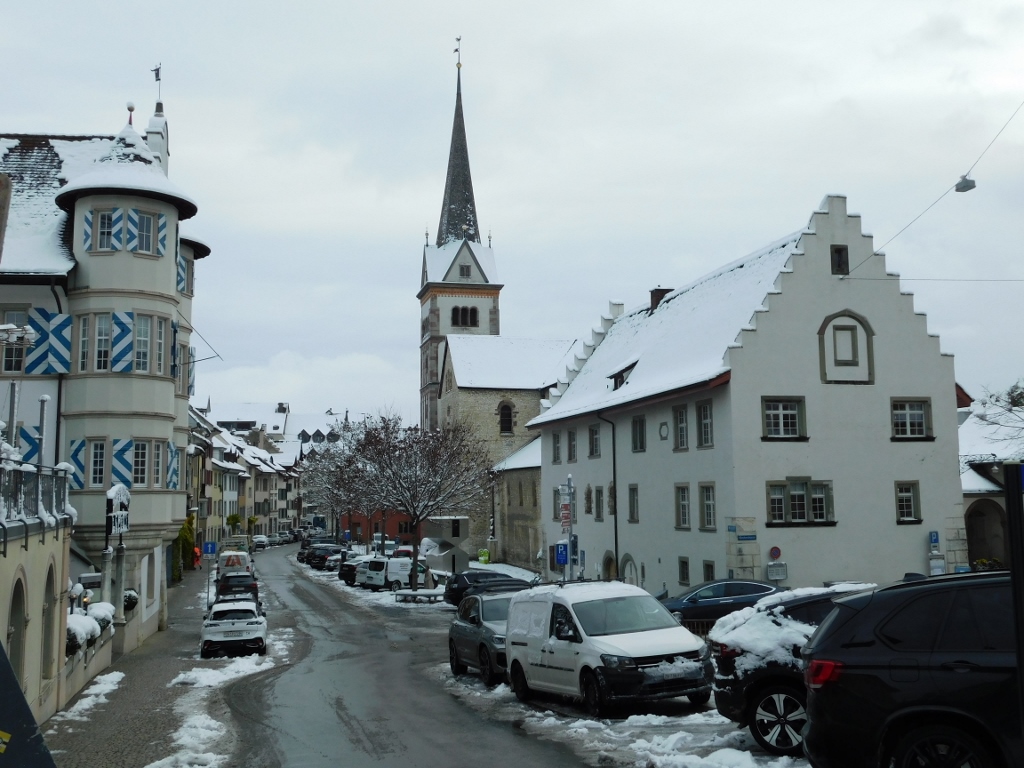 All Saints’ Church
In the immediate vicinity of the All Saints’ Church is the Government House from the 17th century that features interesting facades, as well as a beautiful stepped gable.
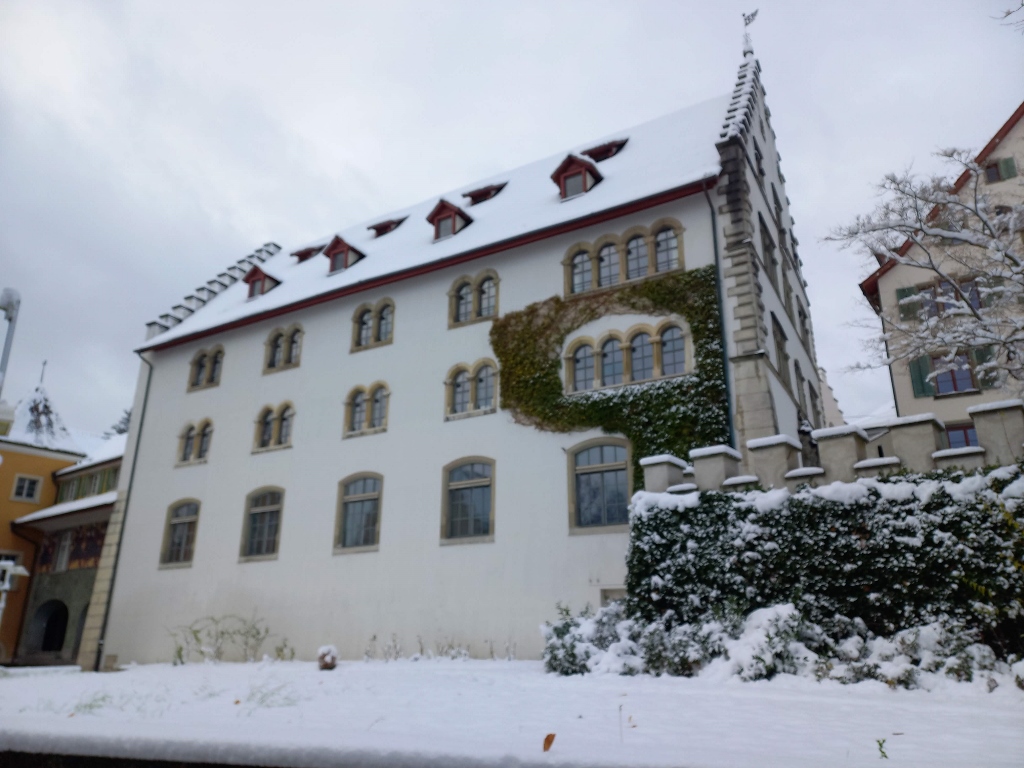 Schaffhausen, a detail
Now, I also took a walk to the Reformed Church of St. John. In fact, I had already passed by it when I was walking along Vodergasse, but it was only now that I visited it.
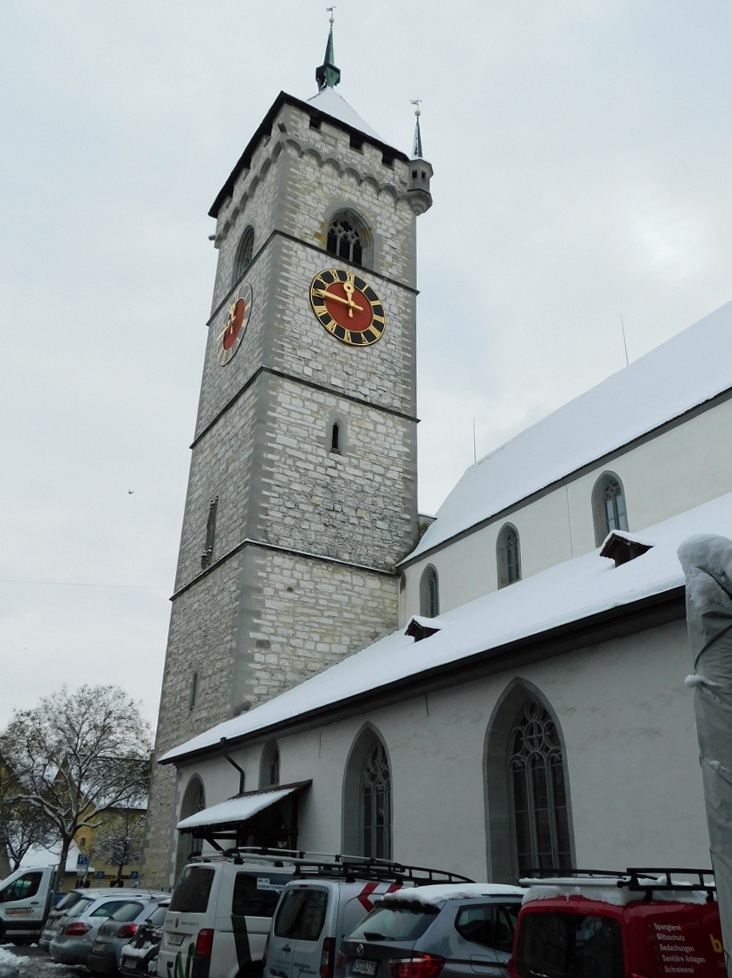 Reformed Church of St. John
The construction of the Romanesque church began around the year 1000, but it was replaced by a new one in the Gothic style in the 14th century. Over time, the church underwent expansions and certain modifications.
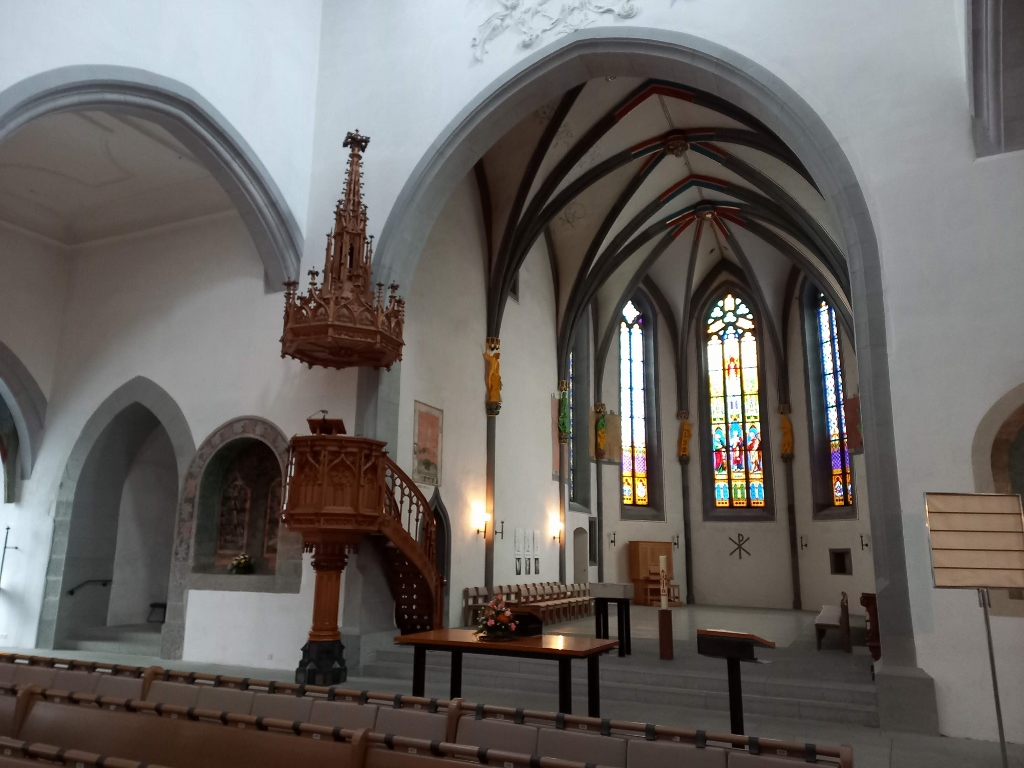 Reformed Church of St. John, a detail
From this church, I headed towards another interesting landmark in the city, the Munot Fortress, which dates back to the 16th century.
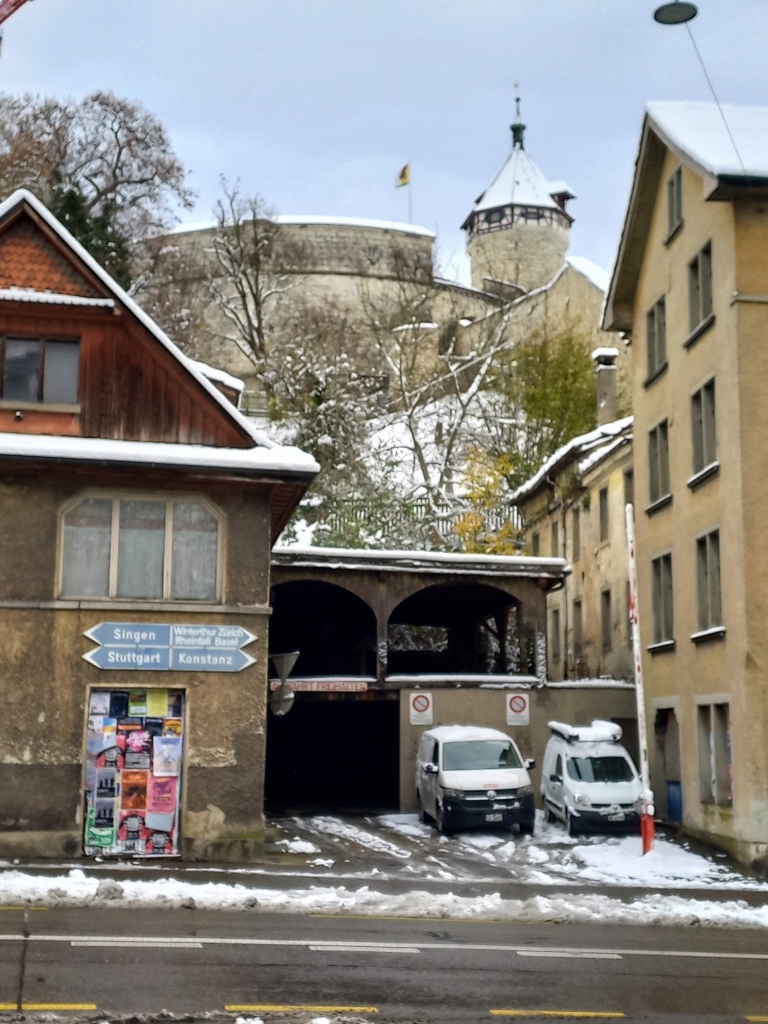 Schaffhausen, a detail
The fortress was part of the city's fortifications and it is particularly notable for its round keep. I must admit, I was too lazy to climb up there, as I had other plans for the day and needed to keep track of time. On the other hand, the view from the fortress is very beautiful. Maybe I’ll do it another time.
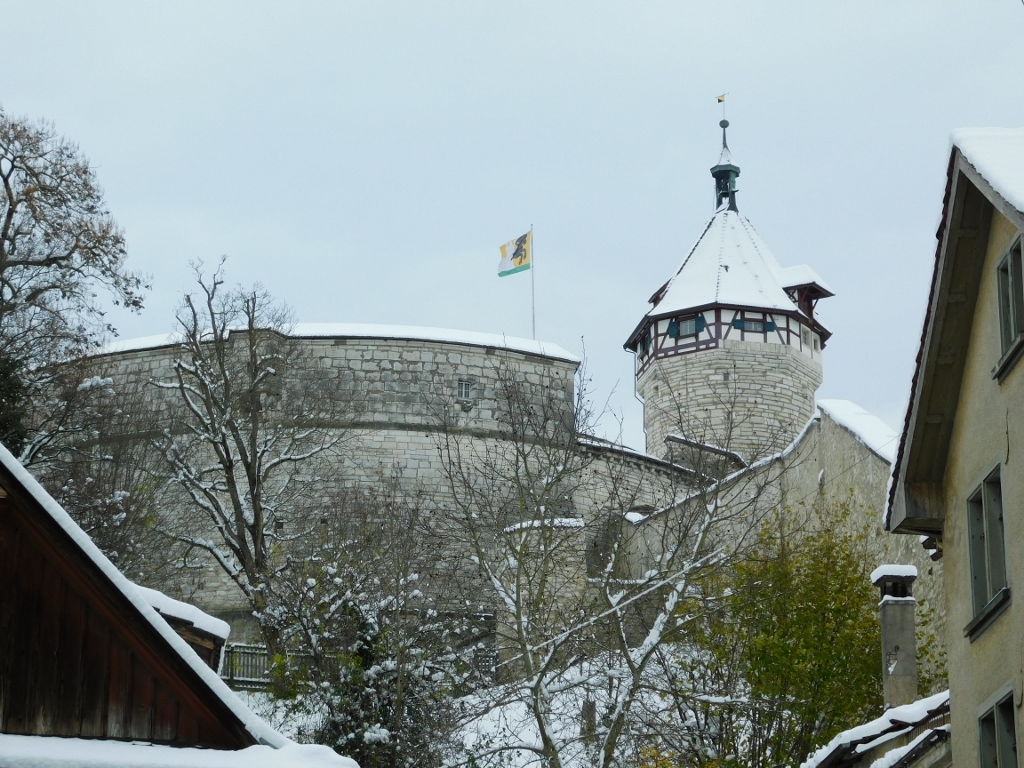 Schaffhausen, a detail
I was thinking whether to go somewhere for a coffee and possibly some cake, but towards the end of my walk through Schaffhausen, a bit of blue sky started to appear, so I decided not to take a coffee break in the town itself. Instead, I chose to head to the Rhine Falls.
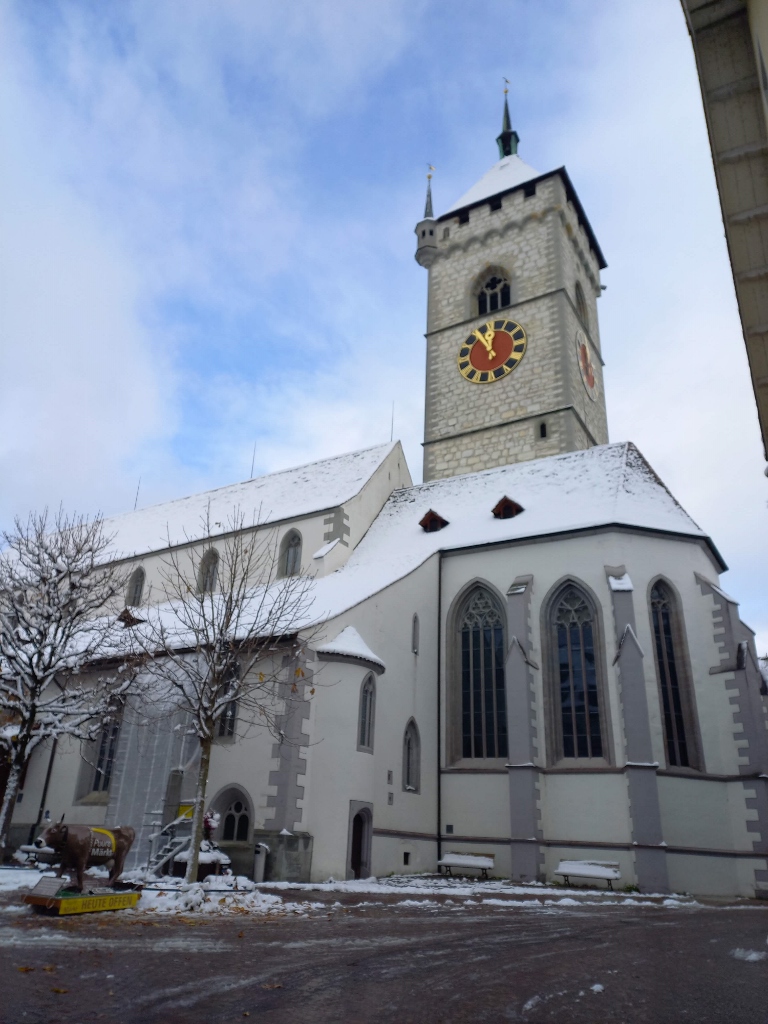 Reformed Church of St. John, but with a little bit more of the blue sky
This was an excellent idea, as the weather conditions changed quite quickly. I took a local train from Schaffhausen and thus transferred to the Neuhausen Rheinfall station. From there, a rather steep street leads down to the river, but it wasn’t a problem because there are plenty of signs indicating where to go.
When I reached the riverbank, there were just a few remnants of blue sky and some sun rays, just enough to take more beautiful photos and then the snow slowly started fall. It didn’t bother me at all.
 The Rhine Falls
The Rhine Falls are the largest and most powerful waterfalls in continental Europe. Their spectacular nature, as it is truly impressive, doesn’t come from their height, which is just over 20 m, but from the river carrying a large volume of water to this point that is 150 m wide. This is especially true during high-water periods (around July).
However, I wasn’t the least bit disappointed with the situation in late November. In fact, I was truly amazed and I expressed that to myself through photography. I took a little walk along the path with stairs, which serves as a viewing point and stretches along the right bank of the river, and then I was ready to cross over to the left bank.
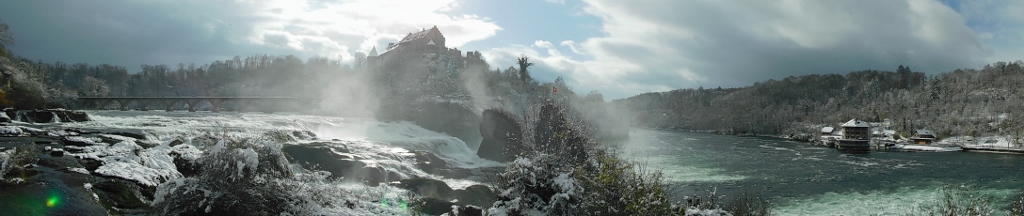 The Rhine Falls
 The Rhine Falls
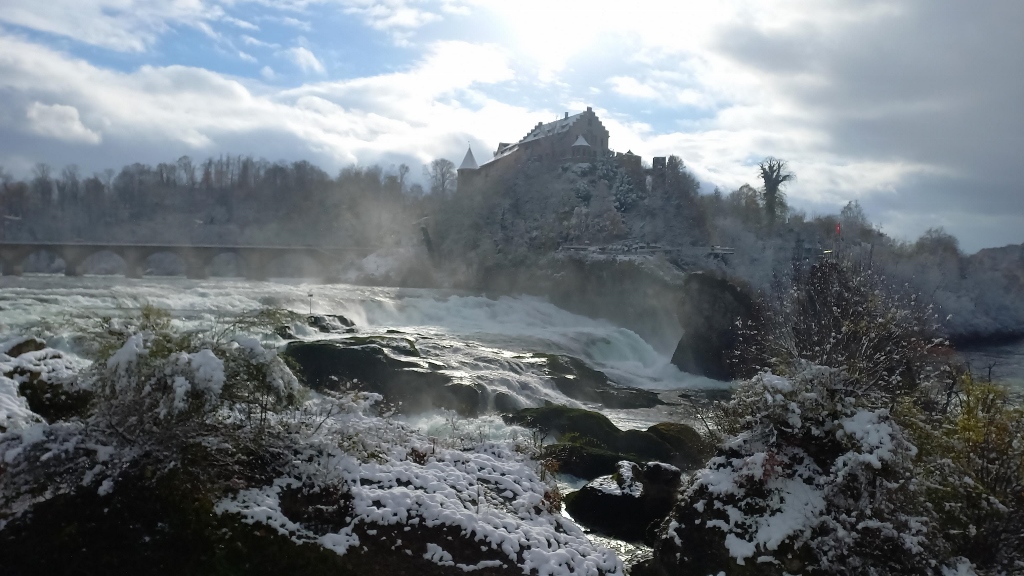 The Rhine Falls
As it can be seen, on the other bank of the Rhine, on the rock that rises there, stands Laufen Castle or Schloss Laufen, which today houses a restaurant and can be visited a bit. The German name is important because of the small train station located there that can also be used by visitors to reach the waterfalls or continue further (as was the case with me).
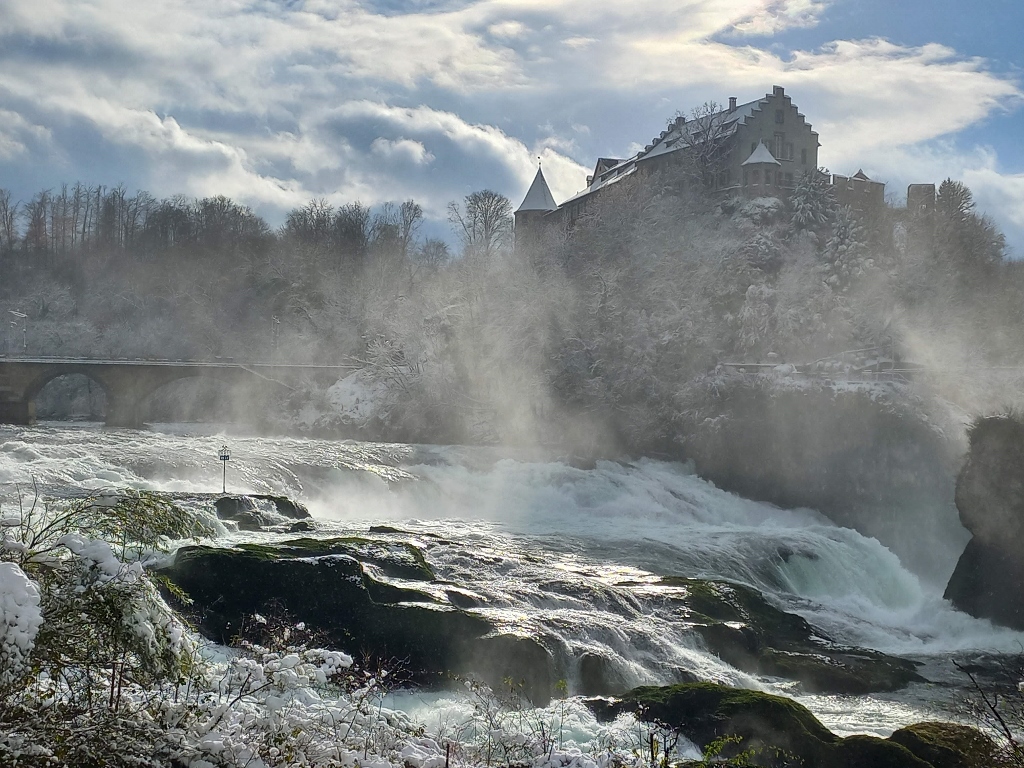 The Rhine Falls
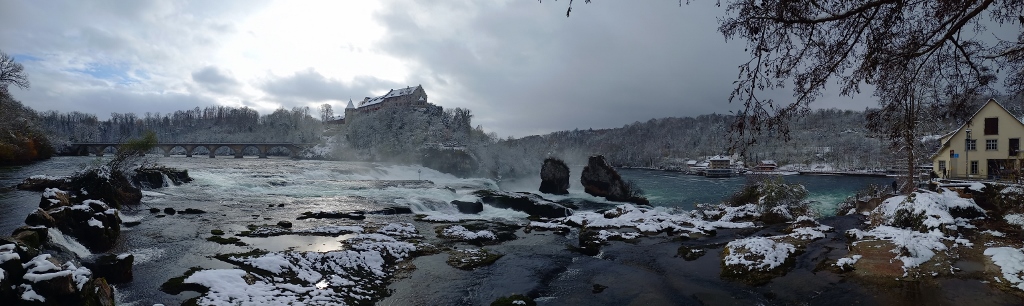 The Rhine Falls
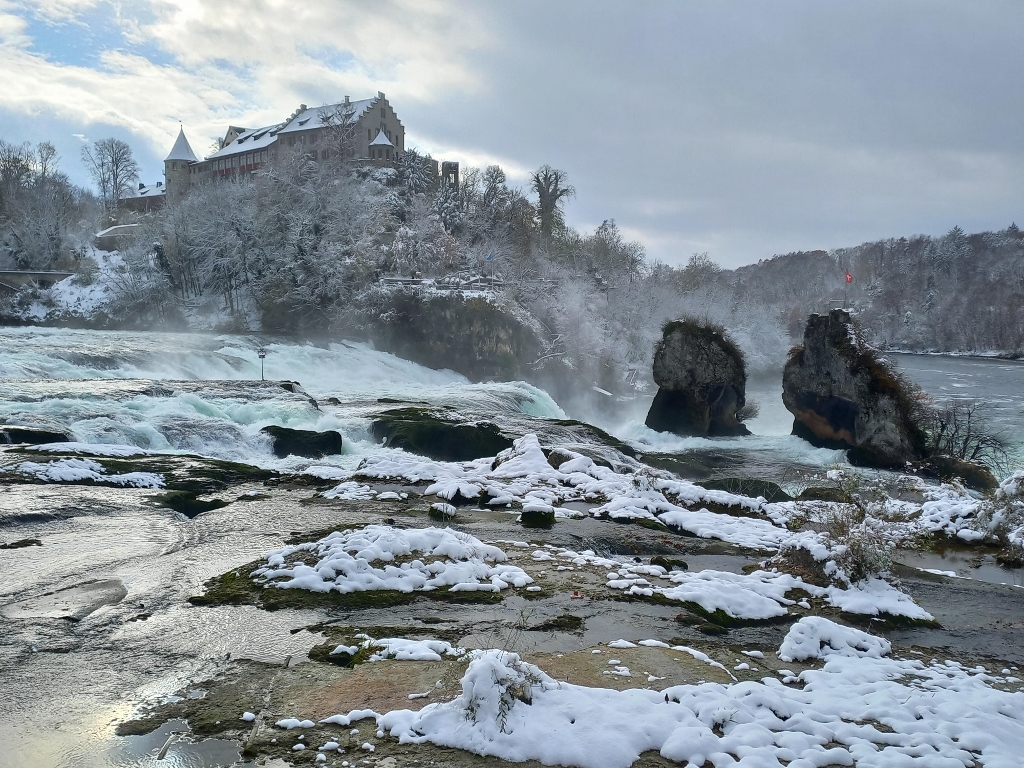 The Rhine Falls
In the area where the river reaches its lower level, there are two rocks and on top of one of them you can see a platform with a flag. During the season, visitors can actually reach this spot, as there are excursion boats that transport people from one bank to the other and they also take visitors to this rock where they can climb up to the platform.
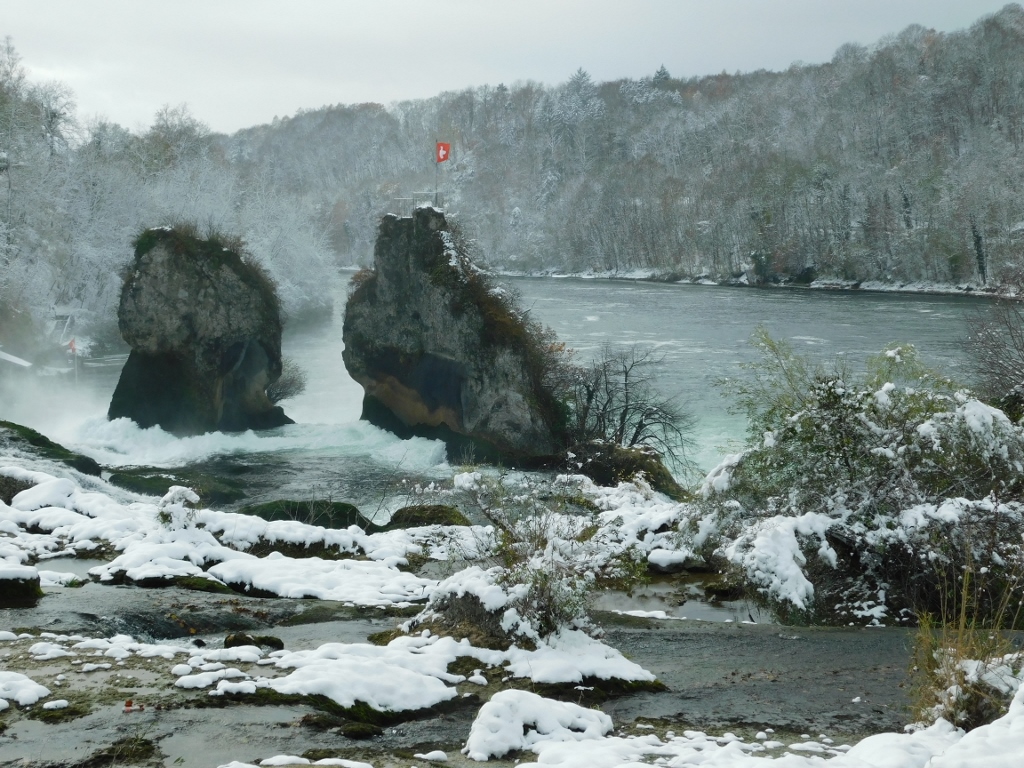 The Rhine Falls
Before moving to the other bank of the river with my story, here is a video illustrating well what it all looks like:
The other side can certainly be reached via the railway-pedestrian bridge that could be seen in several of the previous pictures and that is located not far upstream from the falls. To begin with, the easiest way for a visitor is to climb the steep pedestrian path/stairs that lead from the path with viewing platforms on the right bank of the river and then continue along the path towards the bridge.
One of the advantages of visiting the falls in late autumn or winter is that there are no leaves obstructing the view.
 The Rhine Falls
When you reach the bridge, there are walking paths on both sides, while I decided to take the one on the side of the waterfall.
 The Rhine Falls
Having crossed the bridge, I followed the path that led me to the entrance of the castle.
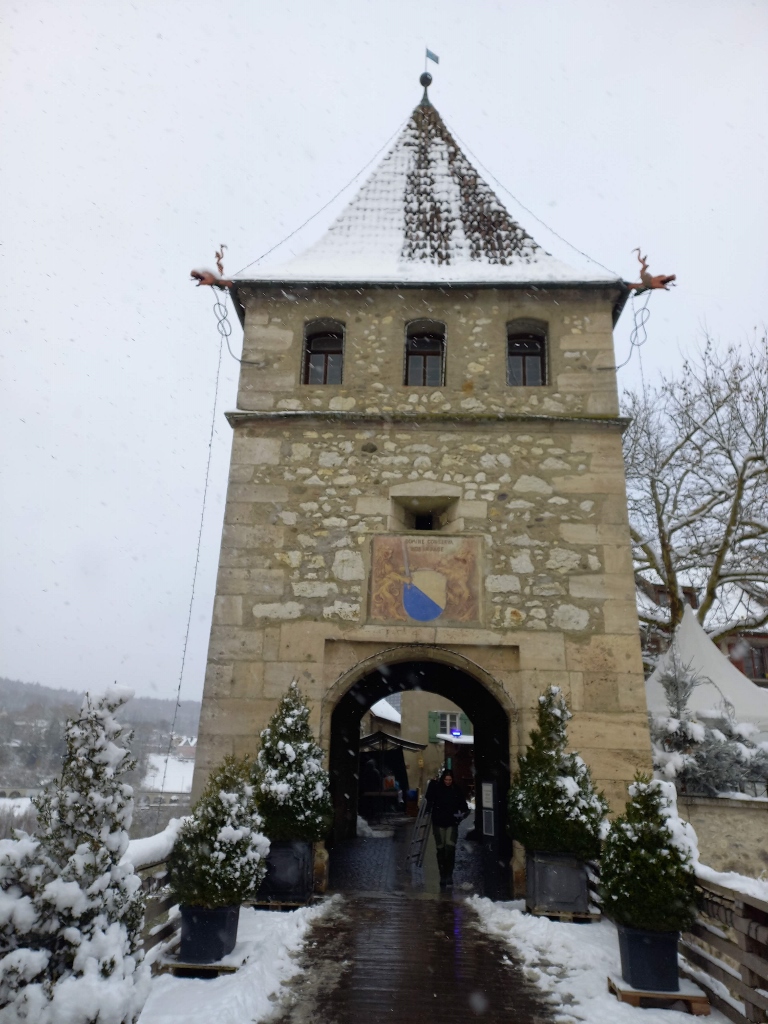 Entrance to Schloss Laufen
At the time of my visit, stalls were being set up for the Christmas market in the castle courtyard, but I wasn’t interested in that or visiting the restaurant. I wanted to go down to the waterfalls and for that it was enough to follow the arrows within the castle, as they lead to an elevator built for this purpose. Of course, it’s possible to walk down, but this was easier and faster for me.
Unlike the right bank of the Rhine, where you can freely access all the viewpoints, here you need to pay for the entry, as a few spots with great views were specifically created for enjoying the waterfalls in a picturesque way, which I think will be evident in my photos below. By the way, tickets can be purchased at a nearby vending machine.
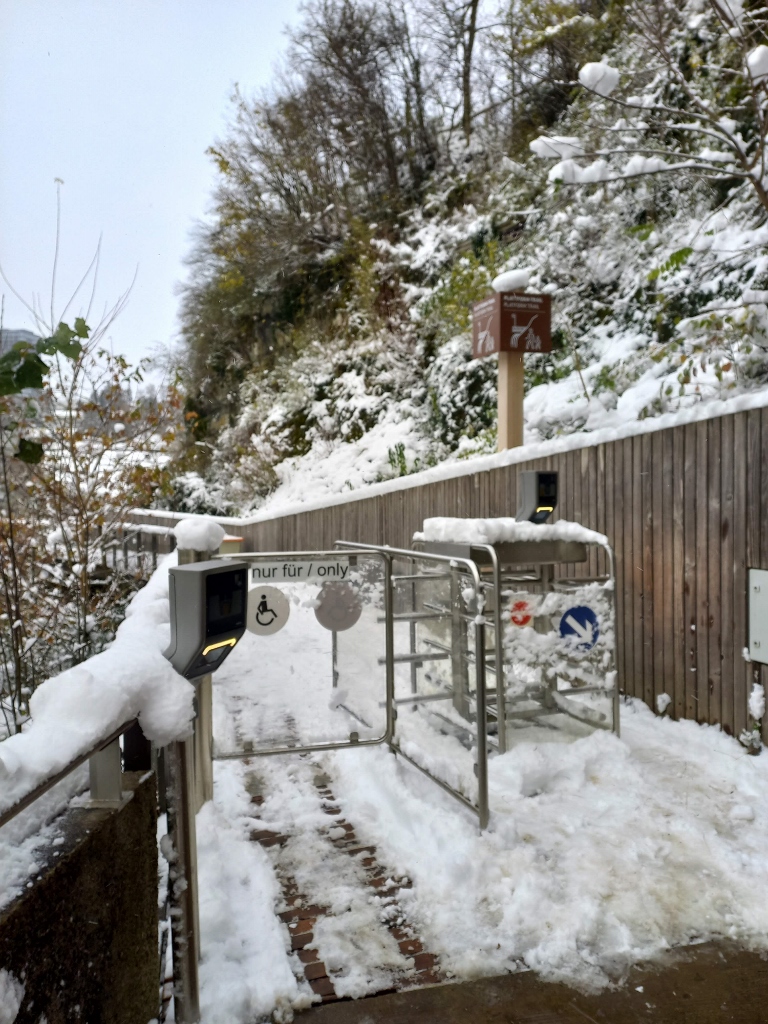 Entrance gate for those with tickets
I don’t have much to add here and I think the photos beautifully illustrate both the waterfalls and what they look like in winter, as well as the level of my admiration for the scene. The latter is reflected in the number of similar photos, but each one is dear to me because either it shows the waterfalls from a slightly different angle or highlights a detail that I find especially interesting. And there’s also a selfie.
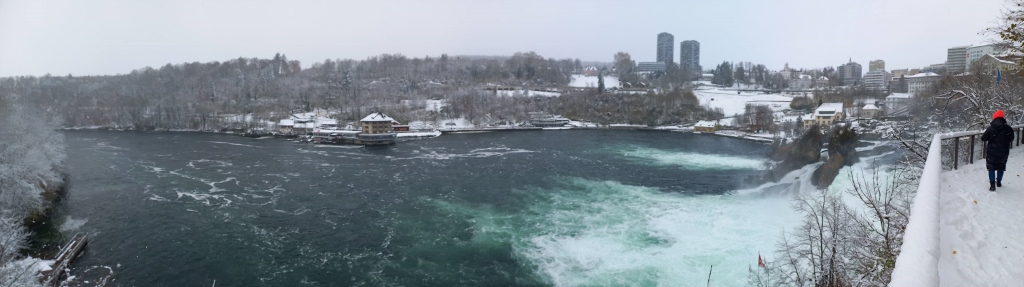 The Rhine Falls
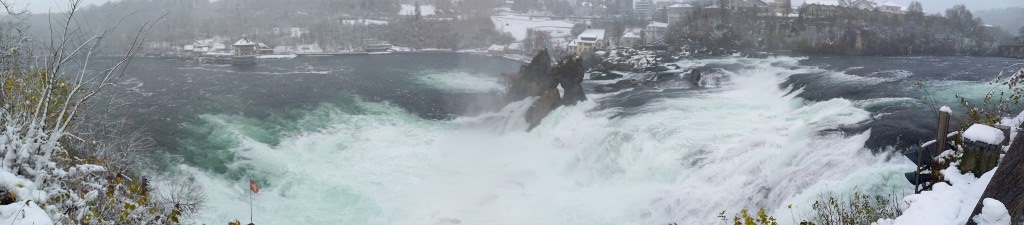 The Rhine Falls
 The Rhine Falls
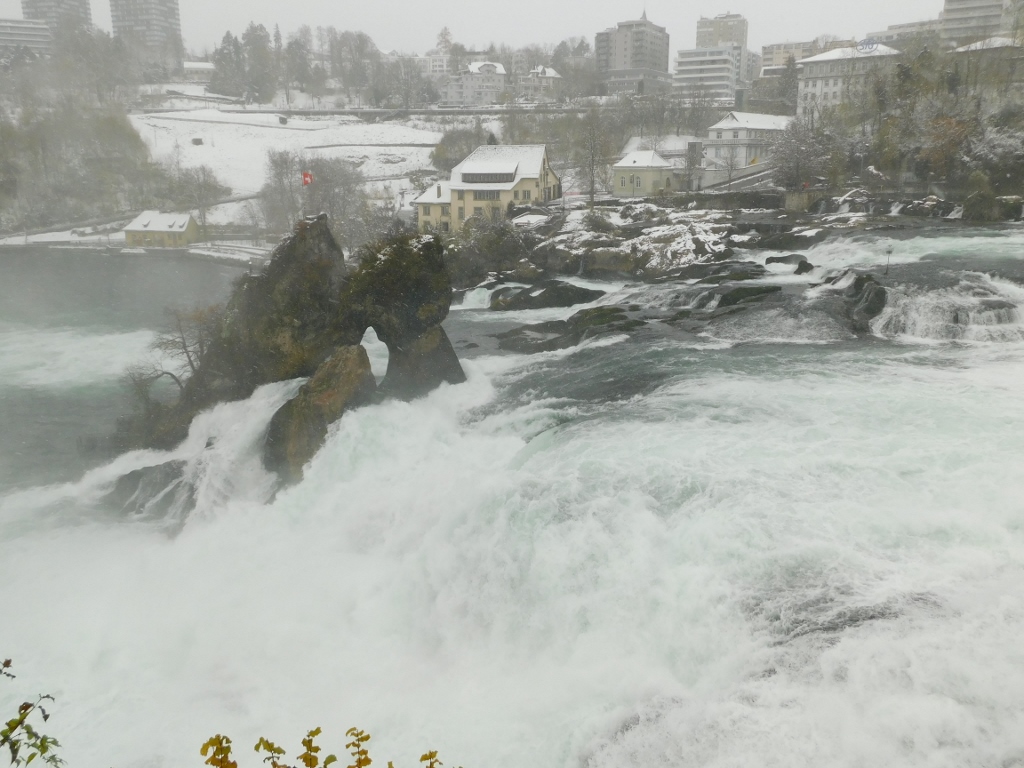 The Rhine Falls
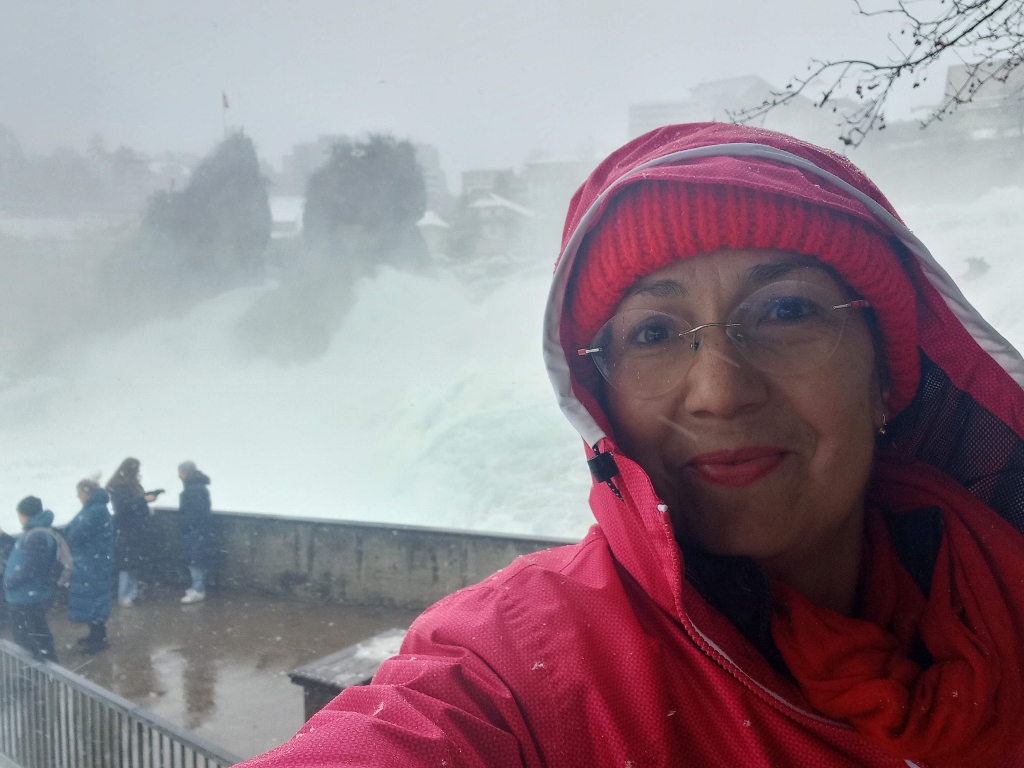 Selfie by the Rhine Falls
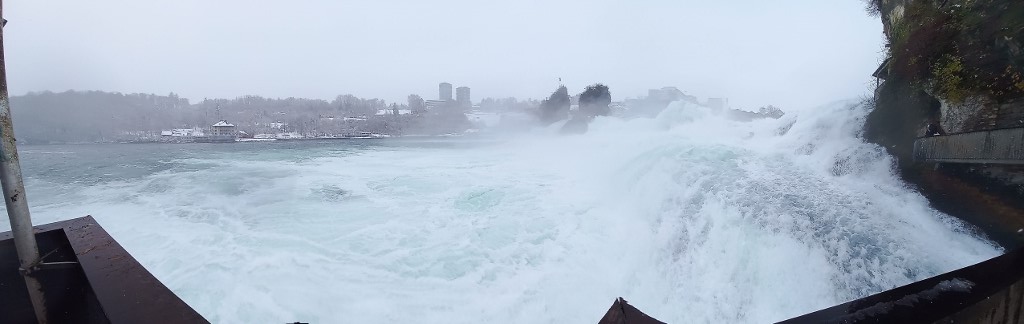 The Rhine Falls
The only thing I could add is that by then, snow had started to fall more intensely. It was fine, but still it was quite a heavy snowfall. However, I managed to make a few video clips, which I compiled into a short recording from the left bank of the Rhine. In the video, you can not only see the powerful waterfalls, but also how heavily the snow is falling and how the platforms on this side of the river are set up, where it almost feels like you could touch the river with your hand.
When I finished visiting everything I wanted to see there, I climbed the path to the nearby local train station – Schloss Laufen am Rheinfall. It is possible to get to this station from Zurich and return (I didn’t investigate that), but I took the train back to Schaffhausen, as I still had more plans for sightseeing in this part of Switzerland.
From there, I transferred to Stein am Rhein. It’s a small town, but it has an incredibly beautiful centre. Although you could talk about several streets in the old town, I think everything is kind of concentrated around the main square and the street leading from it towards an old tower that clearly once stood at the entrance to the fortified town. The guidebook I was using also mentioned a museum within the monastery, but it was closed and I’m not sure I would have been interested in visiting the museum on this occasion anyway. It also mentioned a castle on top of a hill, but I only took a few photos of it from the flat sections and that was about it.
However, the very centre of the old town is so exceptionally picturesque that it’s more than enough to justify coming here, even if it is not on the way for some visitors.